
Civil Law Paper-I is a subject in the Civil Judge competitive examination 2026. Here you will find the Civil Judge exam past paper 2026 on the subject of Civil Law Paper-I of KPSC. This Civil Law paper-I is the 1st paper in the Civil Judge Cum Judicial Magistrate’s competitive examination 2026 held by KP High Court, Peshawar. Find below the Civil Judge Civil Law Paper-I Past Paper 2026.
Civil Judge Civil Law Paper-I 2026
The following questions were asked in the paper:
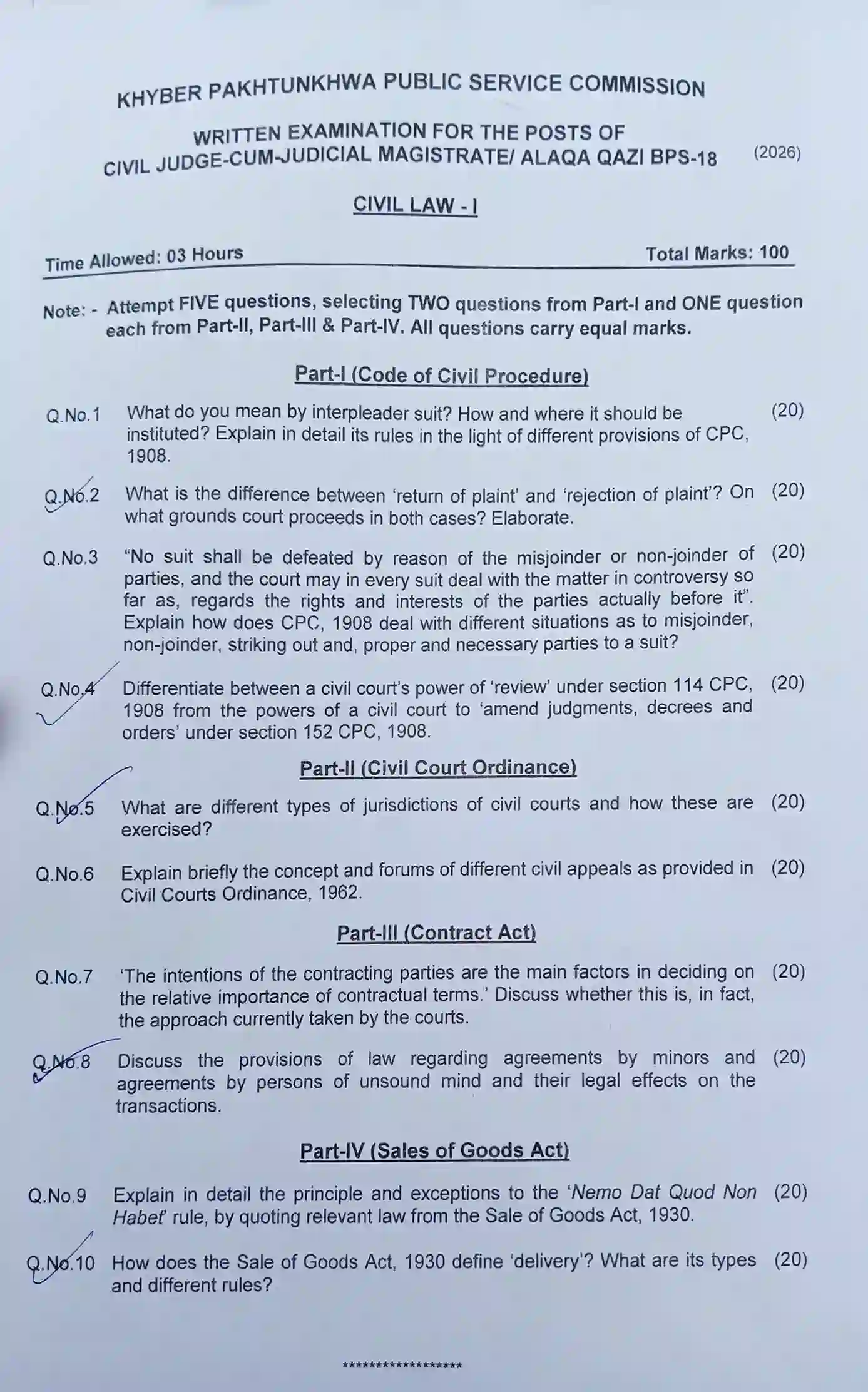
Part I (Code of Civil Procedure)
Q.No.1: What do you mean by interpleader suit? How and where should it be instituted? Explain in detail its rules in the light of different provisions of CPC, 1908.
Q.No.2: What is the difference between ‘return of plaint’ and ‘rejection of plaint’? On what grounds court proceed in both cases? Elaborate.
Q.No.3: “No suit shall be defeated by reason of the misjoinder or non-joinder of parties, and the court may in every suit deal with the matter in controversy so far as regards the rights and interests of the parties actually before it”. Explain how CPC, 1908, deals with different situations as to misjoinder, non-joinder, striking out, and proper and necessary parties to a suit?
Q.No.4: Differentiate between a civil court’s power of ‘review’ under section 114 CPC, 1908, from the powers of a civil court to ‘amend judgments, decrees and orders’ under section 152 CPC, 1908.
Part-II (Civil Court Ordinance)
Q.No.5: What are the different types of jurisdictions of civil courts, and how are these exercised?
Q.No.6: Explain the concept and forums of different civil appeals briefly as provided in the Civil Courts Ordinance, 1962.
Part-III (Contract Act)
Q.No.7: The intentions of the contracting parties are the main factors in deciding on the relative importance of contractual terms. Discuss whether this is, in fact, the approach currently taken by the courts.
Q.No.8: Discuss the provisions of law regarding agreements by minors and agreements by persons of unsound mind and their legal effects on the transactions.
Part IV (Sales of Goods Act)
Q.No.9: Explain in detail the principle and exceptions to the ‘Nemo Dat Quod Non Habet’ rule, by quoting relevant law from the Sale of Goods Act, 1930.
Q.No.10: How does the Sale of Goods Act, 1930, define ‘delivery’? What are its types and different rules?
View the Civil Law-I Paper 2026 here:
Also read:
