
The Islamic Jurisprudence paper is a subject in the Civil Judge competitive examination 2026. Here you will find the Civil Judge exam past paper 2026 on the subject of Islamic Jurisprudence of KPSC. This Islamic Jurisprudence is the 4th paper in the Civil Judge Cum Judicial Magistrate’s competitive examination 2026 held by KP High Court, Peshawar. Find below the Civil Judge Islamic Jurisprudence Past Paper 2026.
Islamic Jurisprudence Past Paper 2026
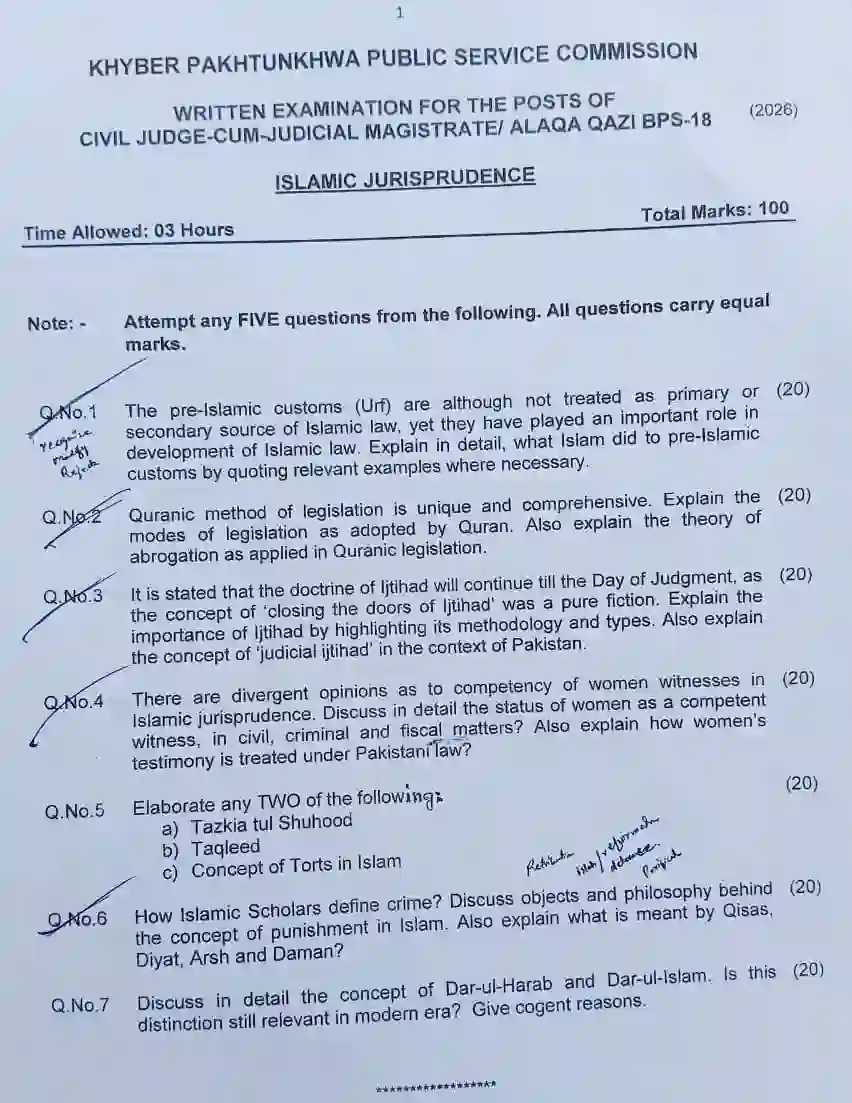
Q.No.1: The pre-Islamic customs (Urf), although not treated as a primary or secondary source of Islamic law, have played an important role in the development of Islamic law. Explain in detail what Islam did to pre-Islamic customs by quoting relevant examples where necessary.
Q.No.2: The Quranic method of legislation is unique and comprehensive. Explain the modes of legislation as adopted by the Quran. Also, explain the theory of abrogation as applied in Quranic legislation.
Q.No.3: It is stated that the doctrine of Ijtihad will continue till the Day of Judgment, as the concept of ‘closing the doors of Ijtihad’ was a pure fiction. Explain the importance of Ijtihad by highlighting its methodology and types. Also, explain the concept of ‘judicial ijtihad’ in the context of Pakistan.
Q.No.4: There are divergent opinions as to the competency of women witnesses in Islamic jurisprudence. Discuss in detail the status of women as competent witnesses in civil, criminal, and fiscal matters. Also, explain how women’s testimony is treated under Pakistani law?
Q.No.5: Elaborate on any TWO of the following:
a) Tazkia tul Shuhood
b) Taqleed
c) Concept of Torts in Islam
Q.No.6: How do Islamic Scholars define crime? Discuss objects and philosophy behind the concept of punishment in Islam. Also, explain what is meant by Qisas, Diyat, Arsh, and Daman?
Q.No.7: Discuss in detail the concept of Dar-ul-Harab and Dar-ul-Islam. Is this distinction still relevant in the modern era? Give cogent reasons.
Also read:
