
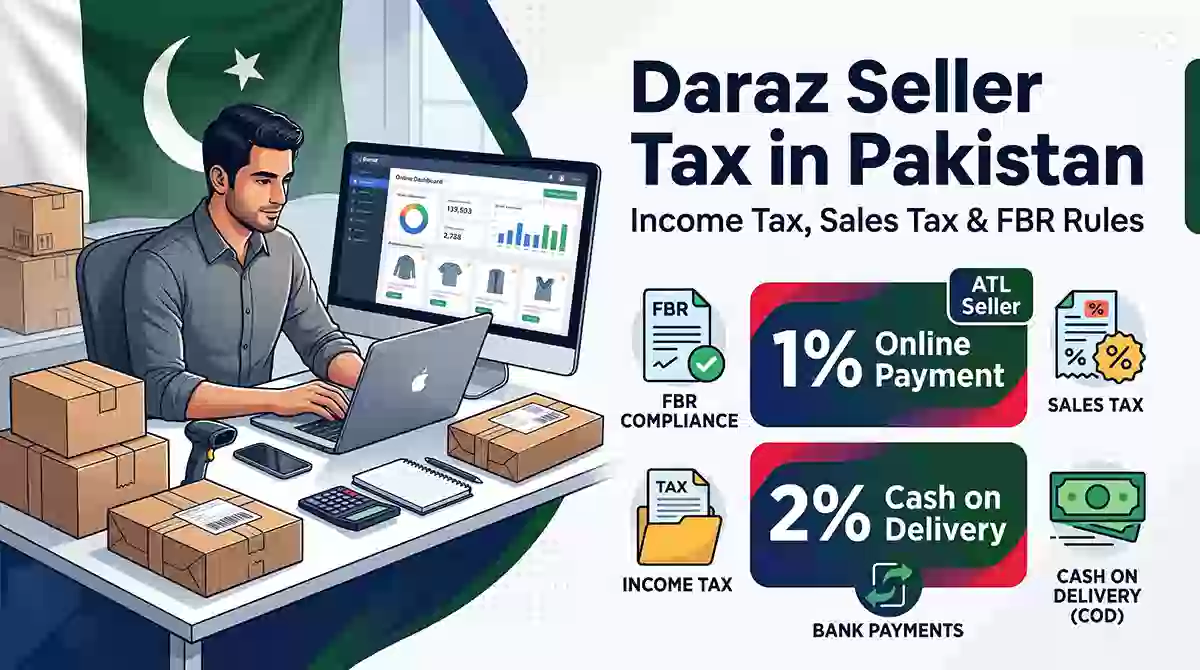
Selling products on Daraz is a popular business opportunity in Pakistan. However, online sellers must understand their income tax and sales tax responsibilities.
Many sellers are confused about Daraz commission, government tax deductions, NTN registration and FBR return filing. The Finance Act 2025 introduced a separate tax system for e-commerce, while the Finance Act 2026 brought further changes for Tax Year 2027.
This guide explains Daraz seller tax in Pakistan including the latest tax rates and rules for online sellers.
1. What Is Daraz Seller Tax in Pakistan?
There is no separate tax called Daraz tax. Online sellers are covered by the e-commerce tax provisions of the Income Tax Ordinance, 2001.
The main provisions are:
- Section 6A: Income tax on payments received from digital e-commerce transactions.
- Section 153(2A): Collection of tax by payment intermediaries and courier services.
- Sales Tax Act, 1990: Sales tax on digitally ordered taxable goods.
For example, when a customer purchases a product through Daraz, the relevant payment intermediary or courier service deducts income tax before settling the payment with the seller.
2. Daraz Seller Income Tax Rates for 2026-27
The applicable income tax rate depends on the payment method and the seller’s Active Taxpayer List (ATL) status.
| Payment method | ATL seller | Non-ATL seller |
|---|---|---|
| Online payment | 1% | 2% |
| Cash on Delivery (COD) | 2% | 4% |
These rates apply to gross receipts, not business profit.
For example, if you sell products worth Rs. 100,000 through online payments, an ATL seller pays Rs. 1,000 in withholding tax, while a non-ATL seller pays Rs. 2,000.
For COD sales of Rs. 100,000, the deductions are Rs. 2,000 and Rs. 4,000, respectively.
3. Is Daraz Commission the Same as Income Tax?
No. Daraz commission and government income tax are separate deductions.
Consider a product sold for Rs. 10,000:
| Particulars | Amount |
|---|---|
| Product sale | Rs. 10,000 |
| Daraz commission | Rs. 1,000 |
| Income tax (1% online payment) | Rs. 100 |
| Delivery charges | Rs. 200 |
| Net payout | Rs. 8,700 |
This is only an example. Actual Daraz charges depend on the product category and seller agreement.
Daraz commission is a business expense, while income tax is deposited with FBR.
Also read: How to Register as DNFBP in FBR IRIS
4. Do Daraz Sellers Need NTN Registration?
Yes. E-commerce sellers are required to register for income tax under the applicable FBR rules.
Small sellers and home-based businesses are not automatically exempt.
Most individuals starting a small Daraz business can operate as individual or sole proprietorship taxpayers. A private limited company is not compulsory for every seller.
You can register through the official FBR IRIS portal.
5. Why Is ATL Status Important?
ATL stands for Active Taxpayer List. It contains taxpayers who have fulfilled the applicable return filing requirements.
ATL status reduces the e-commerce withholding tax rates.
For example, on Rs. 500,000 in monthly online sales:
- ATL seller: Rs. 5,000 tax.
- Non-ATL seller: Rs. 10,000 tax.
Maintaining ATL status can therefore reduce your tax deductions considerably.
6. Is Daraz Seller Tax Final or Adjustable?
The Finance Act 2026 introduced an important change through Section 6A for Tax Year 2027.
The treatment now depends on annual turnover.
Turnover above Rs. 200 million: Tax deducted under Section 6A is adjustable against the actual income tax liability.
Turnover up to Rs. 200 million: Sellers can choose between the final tax regime and the normal tax regime when filing their income tax return.
Under the normal tax regime, taxable business income is calculated under the applicable rules, taking eligible expenses into account.
For example, a seller with low profit margins may benefit from the normal tax regime. A seller with higher profits may find the final tax regime more suitable.
Compare both options before making your decision.
7. Is Sales Tax Also Applicable to Daraz Sales?
Yes. Income tax and sales tax are separate taxes.
The Finance Act 2025 introduced a 2% sales tax collection mechanism for relevant digitally ordered taxable goods under the Eleventh Schedule of the Sales Tax Act, 1990.
The treatment depends on the seller’s category:
- For cottage industry and retailers other than Tier-1 retailers, the collected tax is treated as final discharge of sales tax liability on those supplies, with no input tax adjustment.
- For other persons, the collected amount is adjustable against output tax payable in the sales tax return.
Certain registration exceptions apply. Sellers should check their classification and registration requirements before assuming that they are exempt.
Relevant tax authorities include FBR, Punjab Revenue Authority (PRA), Sindh Revenue Board (SRB), KPRA and BRA, depending on the nature and location of the business.
Remember: The 2% sales tax is different from the 1%, 2% and 4% income tax deductions.
8. How to Calculate Daraz Tax on Monthly Sales
Suppose your monthly sales are:
- Online payments: Rs. 60,000.
- COD payments: Rs. 40,000.
- Total sales: Rs. 100,000.
For an ATL seller:
| Payment method | Calculation | Tax |
|---|---|---|
| Online | 60,000 × 1% | Rs. 600 |
| COD | 40,000 × 2% | Rs. 800 |
| Total | Rs. 1,400 |
For a non-ATL seller, the total deduction would be Rs. 2,800.
These figures cover income tax only, not sales tax, Daraz commission or delivery charges.
9. How to File an FBR Income Tax Return as a Daraz Seller
Even if tax has already been deducted, sellers must fulfil their applicable annual return filing requirements.
Follow these steps:
- Obtain your NTN and access to IRIS.
- Download your annual Daraz sales and settlement reports.
- Calculate total sales, returns and cancellations.
- Record product purchases, commission, delivery and other business expenses.
- Obtain bank statements and withholding tax certificates.
- Report business income and tax deductions in the appropriate IRIS sections.
- Compare the final and normal tax regimes if eligible.
- Prepare your wealth statement where required.
- Submit your annual income tax return.
Keep your Daraz statements, purchase invoices, bank records and tax certificates as supporting evidence.
10. Common Tax Mistakes Daraz Sellers Should Avoid
Many online sellers make mistakes that can create problems during tax filing.
Avoid these common errors:
- Selling without the required NTN registration.
- Ignoring ATL status.
- Treating Daraz commission as government tax.
- Declaring net bank deposits instead of reconciling gross sales.
- Ignoring returned and cancelled orders.
- Mixing personal and business transactions.
- Claiming withholding tax without supporting evidence.
- Ignoring sales tax registration requirements.
Maintain a separate business bank account and reconcile your Daraz settlements every month.
FAQs
What is the income tax rate for Daraz sellers in Pakistan?
ATL sellers pay 1% on online payments and 2% on COD. Non-ATL sellers pay 2% and 4%, respectively.
Is Daraz tax calculated on profit?
No. The withholding tax is calculated on gross receipts.
Do small Daraz sellers need NTN registration?
Yes. Small and home-based sellers must also fulfil applicable registration requirements.
Is Daraz tax final or adjustable?
For Tax Year 2027, sellers with turnover above Rs. 200 million are subject to adjustable tax. Sellers with turnover up to Rs. 200 million can choose the normal tax regime when filing their return.
Do Shopify sellers also pay e-commerce tax?
Yes. The rules can also cover qualifying digitally ordered sales through Shopify stores, websites and other online platforms.
Conclusion
Daraz sellers in Pakistan must understand income tax, sales tax and FBR registration requirements. For Tax Year 2027, ATL sellers pay 1% on online payments and 2% on COD, while non-ATL sellers pay double these rates.
The Finance Act 2026 also gives eligible sellers with turnover up to Rs. 200 million an option to choose the normal tax regime instead of the final tax regime.
Maintain proper business records, check your ATL status and file your income tax return correctly to avoid unnecessary tax problems.
