
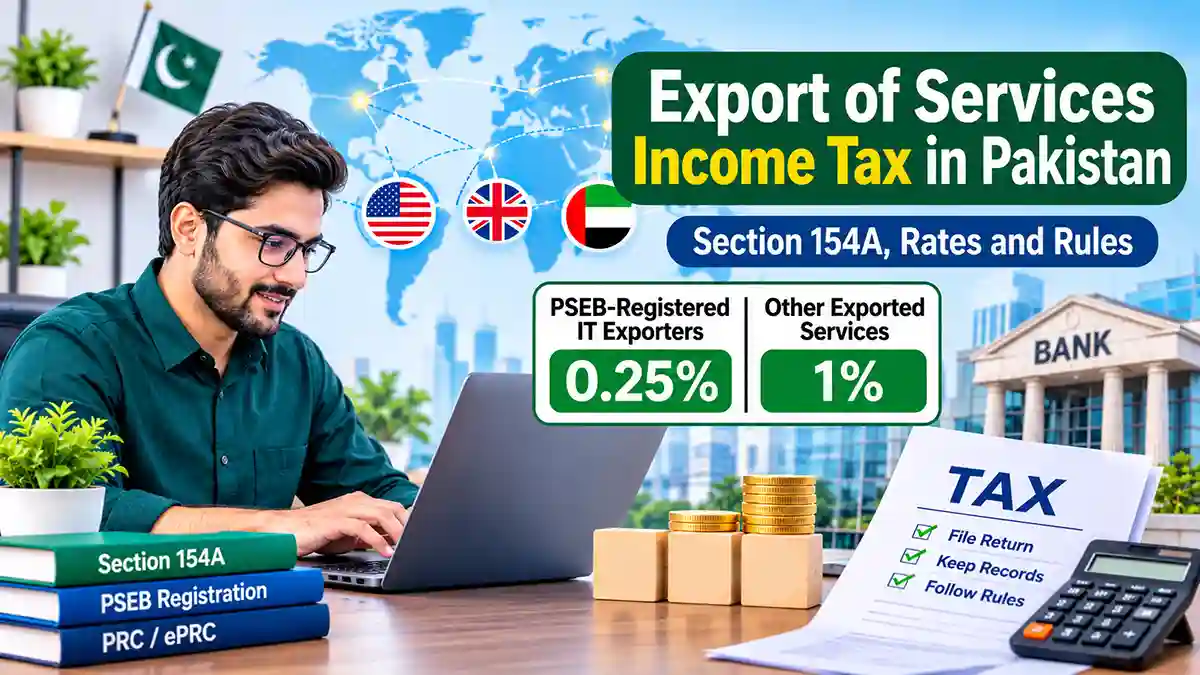
Pakistan has become an important source of freelance, software development, digital marketing and other professional services for foreign businesses. Many Pakistanis now earn dollars, pounds and dirhams by working with clients outside the country.
However, earning money from foreign clients also creates tax responsibilities in Pakistan. Freelancers and service exporters often have questions about the applicable tax rate, PSEB registration, bank deductions and income tax returns.
The main provision covering the export of services is Section 154A of the Income Tax Ordinance, 2001.
This guide explains the export income tax rules for Tax Year 2027 (July 1, 2026, to June 30, 2027) in simple English. It also covers the changes introduced through the Finance Act 2026.
What Is Export of Services Income Tax in Pakistan?
Export of services means providing services to clients outside Pakistan and receiving payment for those services through recognised payment channels.
For example:
- A Pakistani software developer creates an application for a US company.
- A WordPress developer builds a website for a UK client.
- A graphic designer provides design services to a business in Dubai.
- A consultant provides professional services to a foreign company.
These activities can fall under the export of services provisions of Section 154A.
The law requires an authorised dealer in foreign exchange, generally a bank, to deduct income tax when the foreign exchange proceeds are realised.
Export of Services Tax Rates for Tax Year 2027
The tax rate depends on the type of service and the exporter’s PSEB registration status.
| Type of exported service | Tax rate |
|---|---|
| Eligible IT and IT-enabled services by PSEB-registered exporters | 0.25% |
| Other exported services | 1% |
These rates apply to the gross export proceeds realised through the relevant banking channel.
0.25% Tax Rate for PSEB-Registered IT Exporters
The government provides a reduced tax rate to eligible exporters of computer software, IT services and IT-enabled services registered with the Pakistan Software Export Board (PSEB).
To qualify, the exporter must:
- Be registered with PSEB.
- Hold the required PSEB certification.
- Export eligible IT or IT-enabled services.
- Meet the applicable requirements of Section 154A.
The Finance Act 2026 extended this reduced 0.25% rate up to Tax Year 2029.
This means eligible IT exporters can continue to benefit from the reduced rate during Tax Years 2027, 2028 and 2029, subject to the law.
1% Tax Rate for Other Exported Services
Service providers who do not qualify for the PSEB-linked reduced rate generally fall under the 1% rate.
For example, a consultant providing professional services to a foreign company may fall under this category.
However, the nature of the service must be examined before deciding the applicable rate. Do not assume that every freelance service qualifies for the 0.25% rate.
Also read: Freelancer Tax Calculator 2026-27
Which Services Qualify as IT and IT-Enabled Services?
This is an important question for freelancers.
IT services generally include software development, computer programming and other technology-related services.
The Income Tax Ordinance also recognises various IT-enabled services, including:
- Graphic design services
- Accounting services
- Human resource services
- Data entry operations
- Cloud computing services
- Data storage services
The legal definitions are not limited to these examples. The exact classification should be checked before claiming the reduced rate.
Remember that PSEB registration alone does not make every type of foreign income eligible for the 0.25% rate.
Learn more: Freelancer Income Tax Return Course in Pakistan
How Is Export Income Tax Calculated?
The tax is calculated on gross export proceeds, not on net profit.
Consider the following example.
Suppose a freelancer receives Rs. 1,000,000 from foreign clients during the tax year.
| Particulars | PSEB-registered IT exporter | Other service exporter |
|---|---|---|
| Gross export receipts | Rs. 1,000,000 | Rs. 1,000,000 |
| Applicable rate | 0.25% | 1% |
| Tax deducted | Rs. 2,500 | Rs. 10,000 |
| Balance after deduction | Rs. 997,500 | Rs. 990,000 |
The tax is calculated on the gross amount. Business expenses such as internet bills, software subscriptions, salaries and office rent do not reduce this particular withholding calculation.
Who Deducts Export Income Tax?
Under Section 154A, the authorised dealer in foreign exchange deducts tax when the foreign proceeds are realised.
For example, suppose a Pakistani freelancer receives $2,000 from a foreign client.
When the payment is received through the relevant banking channel, the bank deducts the applicable tax and credits the remaining amount to the freelancer’s account.
The exporter should check the bank statement and obtain proper evidence of the deduction.
What Are PRC and ePRC?
PRC means Proceeds Realisation Certificate.
ePRC means Electronic Proceeds Realisation Certificate.
These documents provide evidence that foreign payment proceeds have been received through banking channels.
Freelancers and service exporters should maintain their PRCs or ePRCs because they help establish the source and nature of foreign receipts.
Other useful records include client invoices, contracts, bank statements and payment platform statements.
Is Tax Under Section 154A Final or Adjustable?
Section 154A provides for final taxation of income from the covered transactions when the statutory conditions are fulfilled.
These conditions generally include:
- Filing the annual income tax return.
- Filing withholding tax statements where required.
- Filing applicable federal or provincial sales tax returns where required.
There is an exception to the sales tax return condition for exporters covered under Section 154A(1)(a), which includes qualifying PSEB-registered IT exporters.
Section 154A(3) also provides that the final tax treatment under subsection (2) does not apply where the taxpayer fails to fulfil the specified conditions or chooses not to be taxed under the final tax regime.
A taxpayer choosing to opt out must exercise that option annually when filing the return.
Therefore, taxpayers should examine their eligibility and filing position before treating the bank deduction as final tax.
Difference Between Sections 154A, 153, 154 and 154B
These sections cover different types of income and payments.
| Section | Nature of income |
|---|---|
| Section 154A | Export of services |
| Section 153 | Payments for services and other specified transactions by local withholding agents |
| Section 154 | Export of goods |
| Section 154B | Revenue received from social media platforms |
Section 154A vs Section 153
Section 154A applies to qualifying export proceeds from services.
Section 153 generally applies when a Pakistani withholding agent makes a payment for specified services.
For example, if a software developer works for a US company, Section 154A may apply.
If the same developer provides services to a Pakistani company, the local payment may fall under Section 153.
The applicable Section 153 rate depends on the nature of the service and other legal conditions.
Section 154A vs Section 154
Section 154 covers the export of goods, while Section 154A covers the export of services.
Under the Finance Act 2026, the withholding tax rate on export proceeds under Section 154 was increased to 1.25%.
This change should not be confused with the 1% rate applicable to other exported services under Section 154A.
Section 154B: Tax on Social Media Income
The Finance Act 2026 introduced Section 154B to cover revenue received from social media platforms.
It applies to digital content creators and social media influencers earning through platforms such as:
- YouTube
- TikTok
The withholding tax rate is 5%.
For resident persons, this deduction is treated as minimum tax. For non-resident persons, it is final tax, subject to the statutory conditions.
The provision also covers payments received through banking channels and intermediaries such as online payment service providers.
YouTubers and other content creators should therefore examine Section 154B instead of automatically treating all platform earnings as ordinary IT export income.
Does Fiverr, Upwork, Payoneer or Wise Change the Tax Rate?
No. The name of the payment platform does not independently decide the applicable tax rate.
For example, a freelancer may receive payments through Fiverr, Upwork, Payoneer or Wise.
The important factors are:
- The actual service provided.
- The location and nature of the client.
- Whether the payment represents export proceeds.
- The applicable PSEB registration and legal requirements.
- The banking and payment records.
Freelancers should keep platform statements, invoices and bank records to support their declared income.
Not every foreign remittance automatically qualifies as export income under Section 154A.
Is Sales Tax Applicable to Exported Services?
Income tax and sales tax are separate matters.
Income tax on export services is governed by federal law, mainly Section 154A.
Sales tax on services is generally governed by provincial laws.
Relevant authorities include:
- Punjab Revenue Authority (PRA)
- Sindh Revenue Board (SRB)
- Khyber Pakhtunkhwa Revenue Authority (KPRA)
- Balochistan Revenue Authority (BRA)
- Federal Board of Revenue (FBR) for Islamabad Capital Territory services
Exported services may qualify for exemptions or zero-rating under the relevant sales tax laws, subject to their conditions.
Therefore, a service exporter should not assume that income tax relief automatically removes all sales tax registration and filing requirements.
How to Declare Export Income in the FBR Income Tax Return?
Receiving payment after bank tax deduction does not remove your annual income tax return obligations.
Freelancers and other service exporters should follow these steps:
- Obtain an NTN and maintain the required FBR registration.
- Collect invoices, client contracts and payment records.
- Download bank statements and PRCs/ePRCs.
- Obtain bank withholding tax certificates.
- Calculate total export receipts for the tax year.
- Declare the income under the correct category in IRIS.
- Report the tax deducted under Section 154A in the relevant withholding tax section.
- Prepare and reconcile the wealth statement where required.
- Submit the annual income tax return.
The income and tax figures reported in IRIS should match the available supporting records.
Documents Required for Export Income Tax Compliance
Service exporters should maintain the following documents:
- NTN registration certificate.
- PSEB registration certificate, where applicable.
- Foreign client contracts and invoices.
- Bank statements.
- PRCs or ePRCs.
- Bank withholding tax certificates.
- Fiverr and Upwork payment statements.
- Payoneer or other payment service records.
- Business expense records.
These documents help explain foreign receipts and support the figures declared in the income tax return.
Common Tax Mistakes Made by Freelancers
Many freelancers make avoidable mistakes when reporting their foreign income.
Some common mistakes include:
- Claiming the 0.25% rate without eligible services and PSEB registration.
- Treating every foreign remittance as export income.
- Mixing local and foreign service receipts.
- Failing to obtain PRCs or ePRCs.
- Ignoring bank tax deduction records.
- Declaring incorrect income in IRIS.
- Treating YouTube monetisation as ordinary IT export income.
- Ignoring provincial sales tax requirements.
- Assuming that bank tax deduction removes the need to file a return.
Proper documentation and correct income classification can prevent many tax problems.
FAQs
What is the export services tax rate in Pakistan for 2026-27?
The rate is 0.25% for eligible IT and IT-enabled service exporters registered with PSEB. Other exported services generally attract 1%.
How long is the 0.25% IT export tax rate available?
The Finance Act 2026 extended the reduced rate up to Tax Year 2029.
Can an individual freelancer get the 0.25% tax rate?
Yes. An individual freelancer can qualify if they are registered and duly certified with PSEB and provide eligible IT or IT-enabled services.
Is export income tax calculated on profit or gross receipts?
The Section 154A withholding tax is calculated on gross export proceeds, not net profit.
Who deducts tax under Section 154A?
The authorised dealer in foreign exchange, generally the receiving bank, deducts tax when the foreign proceeds are realised.
Do freelancers need to file an FBR income tax return after bank deduction?
Yes. The bank deduction does not remove the annual return filing requirement.
Is YouTube income covered under Section 154A?
Revenue received from social media platforms is now specifically covered under Section 154B, which provides for 5% withholding tax.
Is export of services exempt from sales tax?
Exported services may qualify for relief under the relevant provincial or federal sales tax law. The applicable conditions must be checked separately.
Conclusion
Pakistan’s export of services tax rules provide a reduced rate for eligible IT exporters and a separate rate for other service providers.
For Tax Year 2027, the main rates under Section 154A are 0.25% for eligible PSEB-registered IT and IT-enabled service exporters and 1% for other exported services. The reduced IT rate has been extended up to Tax Year 2029.
However, choosing the correct rate is only one part of tax compliance. Freelancers and service exporters should maintain proper invoices, bank statements, PRCs and withholding tax records. They should also declare their income correctly in their annual FBR returns.
Understanding these rules can help service exporters avoid tax mistakes and maintain proper records of their foreign earnings.
