
The CSS Computer Science Paper-I 2026 is an optional paper that tests a candidate’s understanding of core computing concepts, programming fundamentals, data structures, algorithms, and theoretical foundations of computer science. Here you will find the CSS Computer Science Paper-I past paper 2026, along with an overall overview of the paper. Before moving to the questions, this introduction highlights the nature of the paper, the level of conceptual and technical difficulty, and the approach FPSC expects from candidates, helping aspirants understand the paper trend and prepare more effectively for future attempts.
CSS Computer Science Past Paper-I 2026
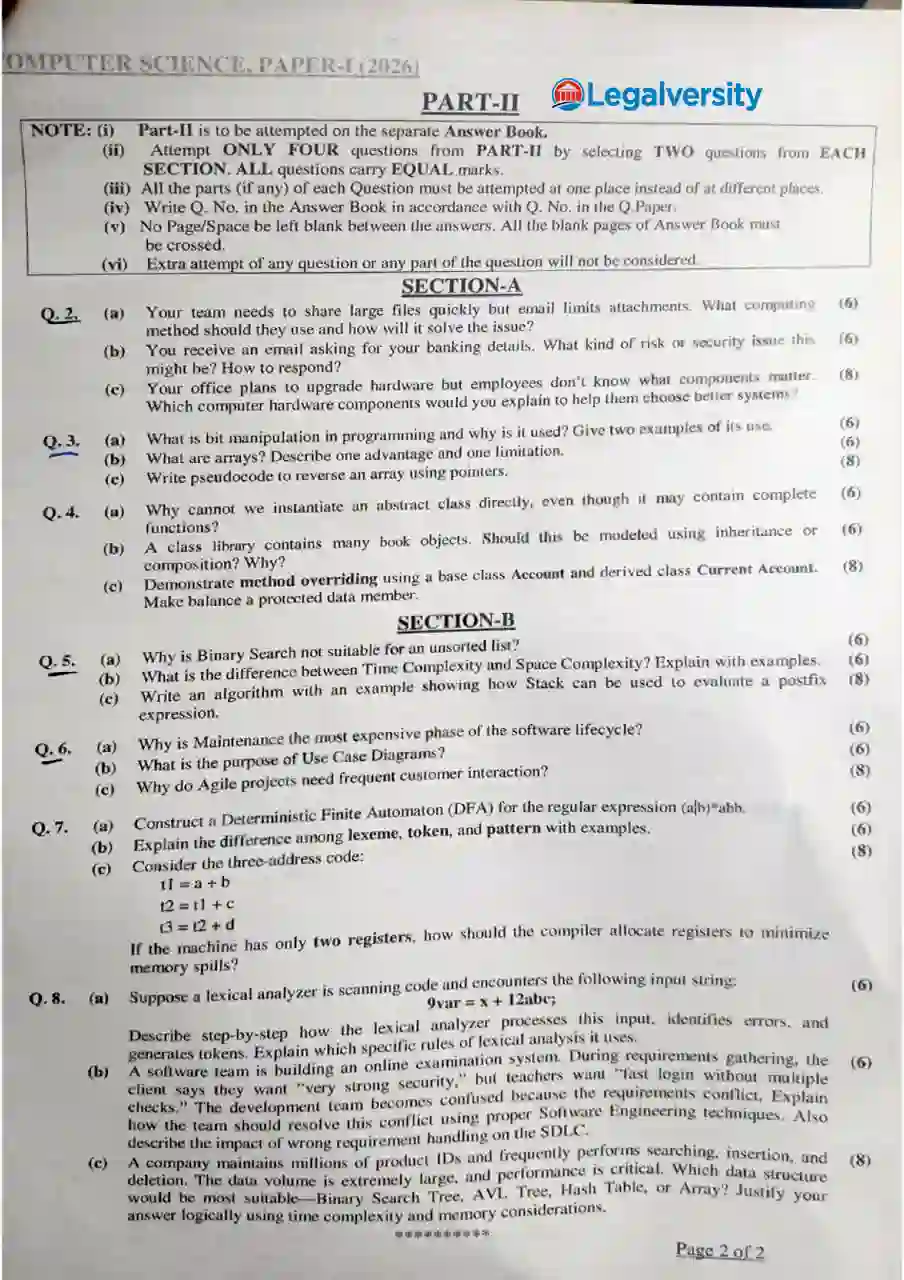
SECTION-A
Q. 2.
- (a) Your team needs to share large files quickly but email limits attachments. What computing method should they use and how will it solve the issue?
- (b) You receive an email asking for your banking details. What kind of risk or security issue this might be? How to respond?
- (c) Your office plans to upgrade hardware but employees don’t know what components matter. Which computer hardware components would you explain to help them choose better systems?
Q. 3.
- (a) What is bit manipulation in programming, and why is it used? Give two examples of its use.
- (b) What are arrays? Describe one advantage and one limitation.
- (c) Write pseudocode to reverse an array using pointers.
Q. 4.
- (a) Why cannot we instantiate an abstract class directly, even though it may contain complete functions?
- (b) A class library contains many book objects. Should this be modeled using inheritance or composition? Why?
- (c) Demonstrate method overriding using a base class Account and a derived class Current Account. Make balance a protected data member.
SECTION-B
Q. 5.
- (a) Why is Binary Search not suitable for an unsorted list?
- (b) What is the difference between Time Complexity and Space Complexity? Explain with examples.
- (c) Write an algorithm with an example showing how a stack can be used to evaluate a postfix expression.
Q. 6.
- (a) Why is Maintenance the most expensive phase of the software lifecycle?
- (b) What is the purpose of Use Case Diagrams?
- (c) Why do Agile projects need frequent customer interaction?
Q. 7.
- (a) Construct a Deterministic Finite Automaton (DFA) for the regular expression.
- (b) Explain the difference among lexeme, token, and pattern with examples.
- (c) Consider the three-address code:
- $t1 = a + b$
- $t2 = t1 + c$
- $t3 = t2 + d$If the machine has only two registers, how should the compiler allocate registers to minimize memory spills?
Q. 8.
- (a) Suppose a lexical analyzer is scanning code and encounters the following input string:
9var = x + 12abc;Describe step-by-step how the lexical analyzer processes this input, identifies errors, and generates tokens. Explain which specific rules of lexical analysis it uses. - (b) A software team is building an online examination system. During requirements gathering, the client says they want “very strong security,” but teachers want “fast login without multiple checks.” The development team becomes confused because the requirements conflict. Explain how the team should resolve this conflict using proper Software Engineering techniques. Also describe the impact of wrong requirement handling on the SDLC.
- (c) A company maintains millions of product IDs and frequently performs searching, insertion, and deletion. The data volume is extremely large, and performance is critical. Which data structure would be most suitable—Binary Search Tree, AVL Tree, Hash Table, or Array? Justify your answer logically using time complexity and memory considerations.
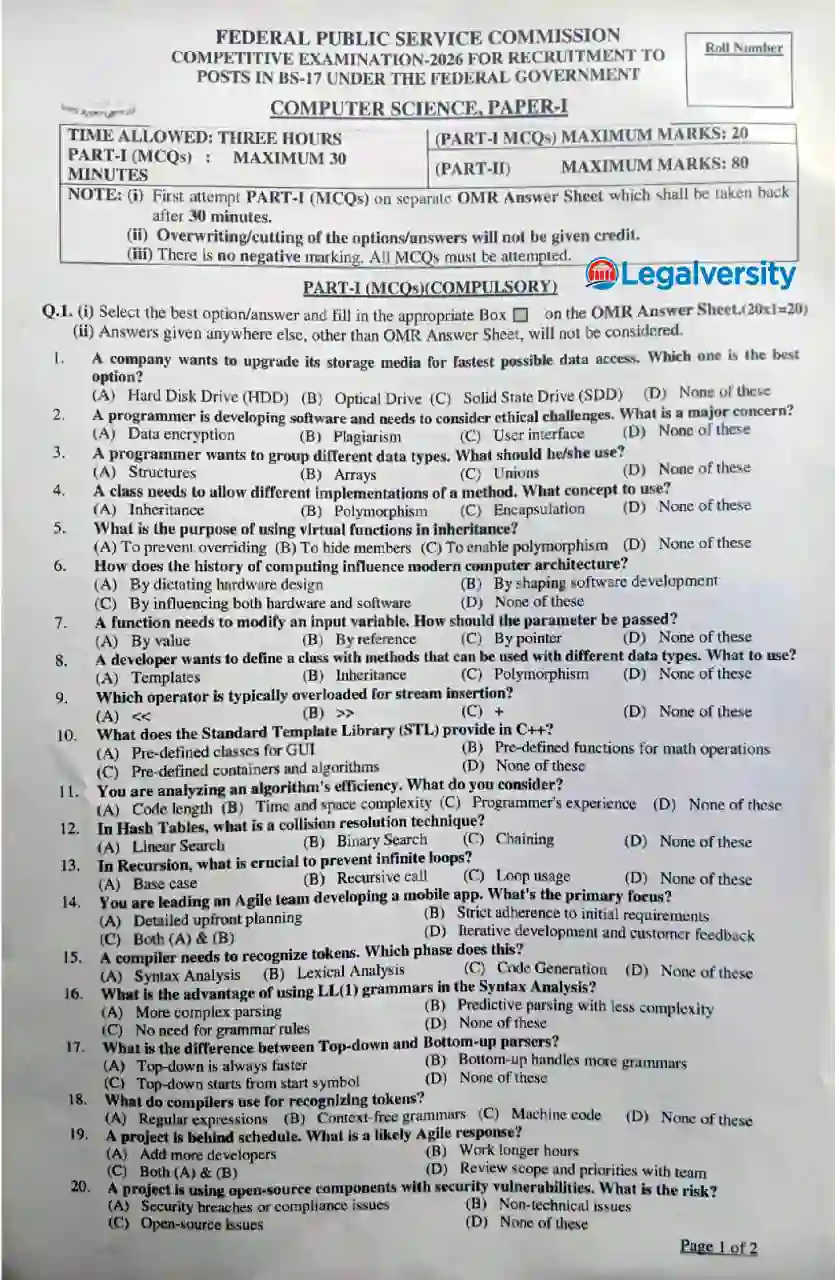
View the CSS Computer Science Past Paper-I 2026:
Stay Connected with Legalversity
Join 70,000+ Readers on WhatsApp - Get instant tax updates, FBR news, and guides.
