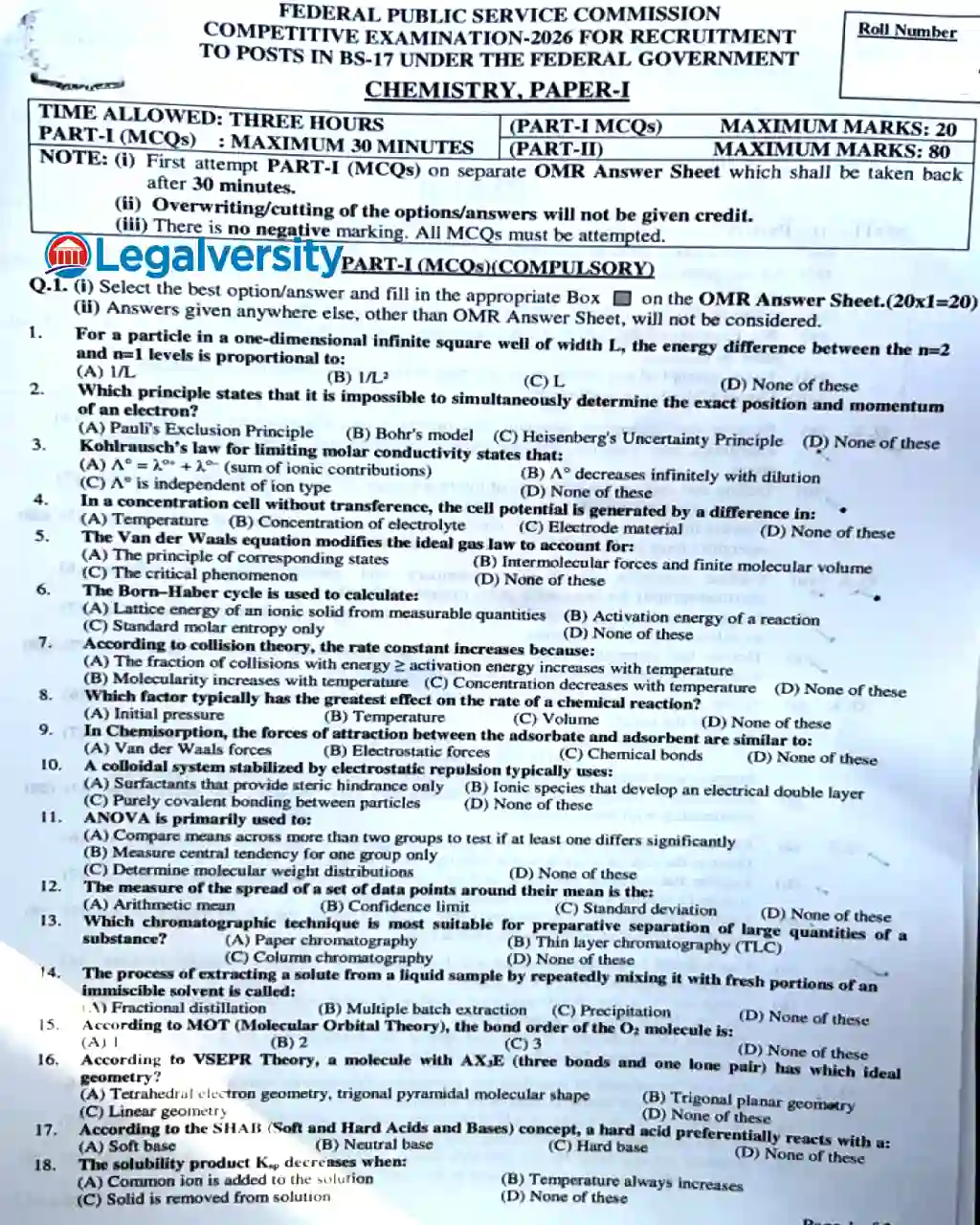
The CSS Chemistry Paper-I 2026 is an optional subject that evaluates a candidate’s understanding of fundamental concepts in physical, organic, and inorganic chemistry. The paper reflects the conceptual and analytical nature of chemistry by testing areas such as atomic structure, chemical bonding, thermodynamics, reaction mechanisms, periodic properties, and quantitative analysis.
The Chemistry paper requires clarity of concepts, balanced chemical equations, accurate numerical problem-solving, and well-labeled diagrams where necessary. Candidates must demonstrate both theoretical understanding and practical application of chemical principles. Here you will find the CSS Chemistry Paper-I past paper for 2026, offering insight into the paper’s structure and the level of precision required to secure high marks.
Read more: CSS Chemistry Paper-II 2026
CSS Chemistry Past Paper-I 2026
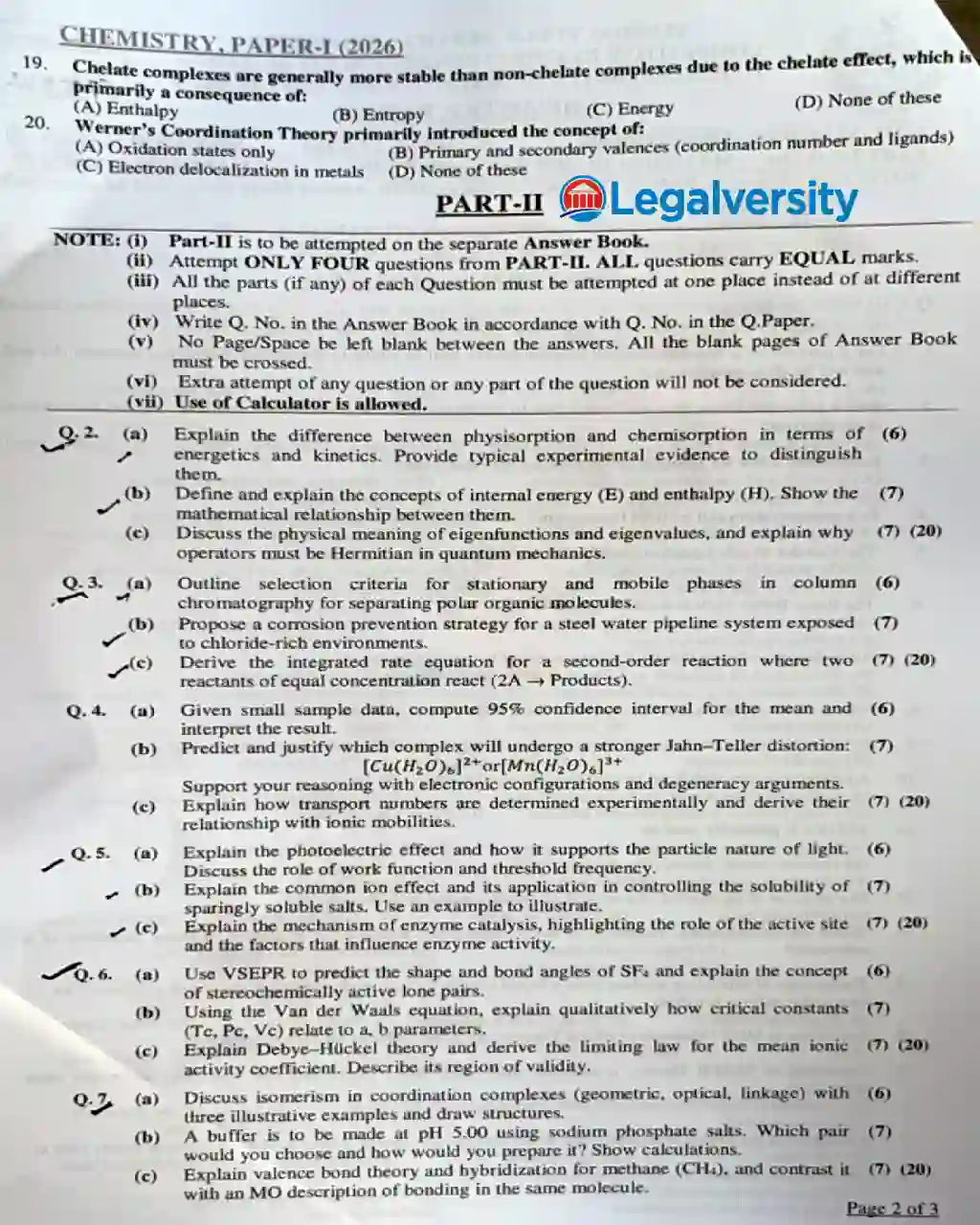
Question No. 2.
- (a) Explain the difference between physisorption and chemisorption in terms of energetics and kinetics. Provide typical experimental evidence to distinguish them.
- (b) Define and explain the concepts of internal energy (E) and enthalpy (H). Show the mathematical relationship between them.
- (c) Discuss the physical meaning of eigenfunctions and eigenvalues, and explain why operators must be Hermitian in quantum mechanics.
Question No. 3.
- (a) Outline selection criteria for stationary and mobile phases in column chromatography for separating polar organic molecules.
- (b) Propose a corrosion prevention strategy for a steel water pipeline system exposed to chloride-rich environments.
- (c) Derive the integrated rate equation for a second-order reaction where two reactants of equal concentration react (2A \rightarrow Products).
Question No. 4.
- (a) Given small sample data, compute 95% confidence interval for the mean and interpret the result.
- (b) Predict and justify which complex will undergo a stronger Jahn-Teller distortion: [Cu(H_2O)_6]^{2+}$ or $[Mn(H_2O)_6]^{3+}. Support your reasoning with electronic configurations and degeneracy arguments.
- (c) Explain how transport numbers are determined experimentally and derive their relationship with ionic mobilities.
Question No. 5.
- (a) Explain the photoelectric effect and how it supports the particle nature of light. Discuss the role of work function and threshold frequency.
- (b) Explain the common ion effect and its application in controlling the solubility of sparingly soluble salts. Use an example to illustrate.
- (c) Explain the mechanism of enzyme catalysis, highlighting the role of the active site and the factors that influence enzyme activity.
Question No. 6.
- (a) Use VSEPR to predict the shape and bond angles of $SF_4$ and explain the concept of stereochemically active lone pairs.
- (b) Using the Van der Waals equation, explain qualitatively how critical constants (Tc, Pc, Vc) relate to a, b parameters.
- (c) Explain Debye-Hückel theory and derive the limiting law for the mean ionic activity coefficient. Describe its region of validity.
Question No. 7.
- (a) Discuss isomerism in coordination complexes (geometric, optical, linkage) with three illustrative examples and draw structures.
- (b) A buffer is to be made at pH 5.00 using sodium phosphate salts. Which pair would you choose and how would you prepare it? Show calculations.
- (c) Explain valence bond theory and hybridization for methane (CH_4), and contrast it with an MO description of bonding in the same molecule.
Question No. 8.
- (a) Discuss the principle of electrophoresis and its application in the separation and characterization of proteins.
- (b) Describe common statistical tests (t-test, chi-square) and their applications in analytical chemistry. Provide decision criteria
- (c) Using initial rate data (suppose), determine reaction order and rate constant by the method of initial rates. (Provide a short worked example.
Read more: CSS Notes & Study Material
View the CSS Chemistry Paper-I 2026