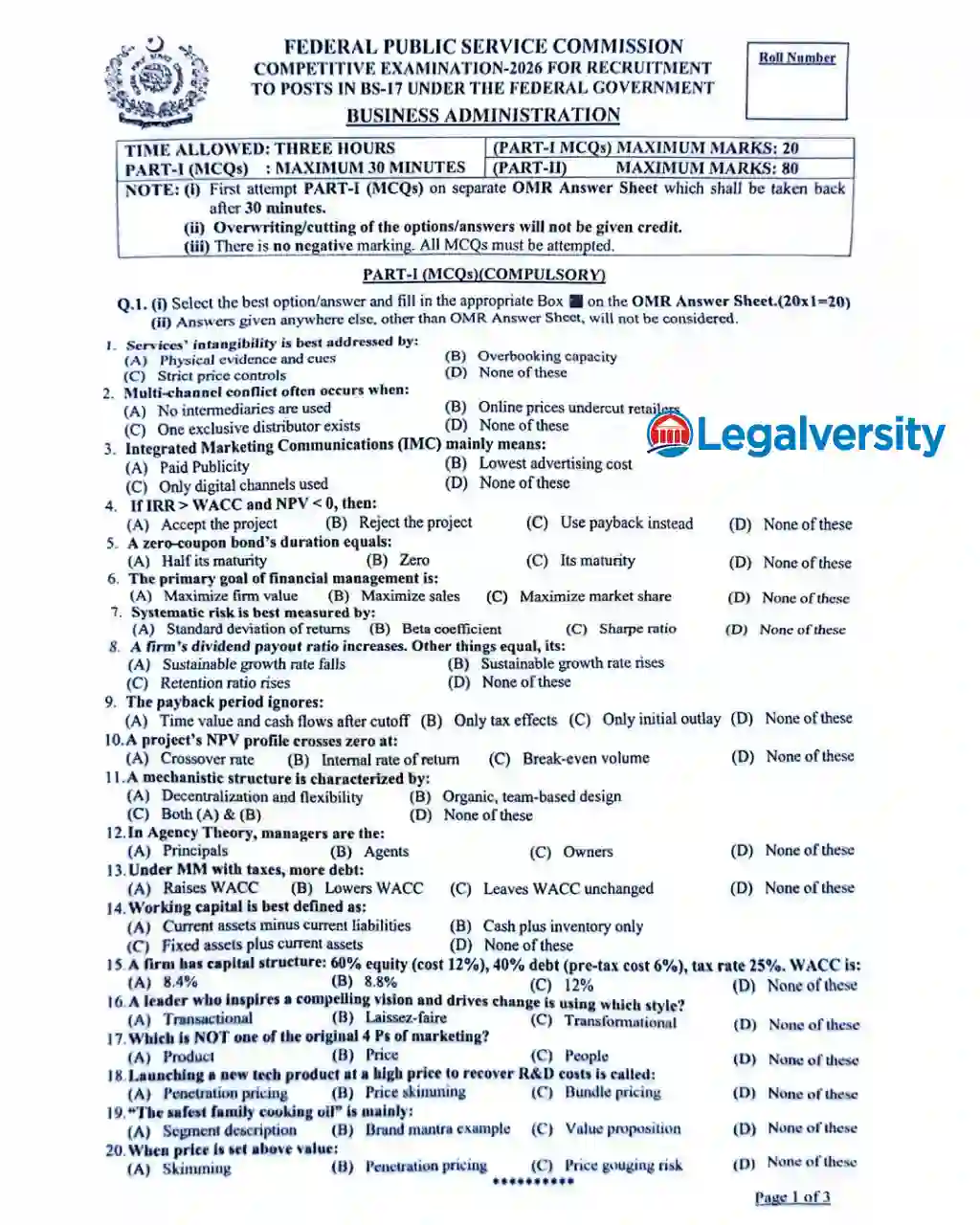
The CSS Business Administration Paper 2026 is an optional subject that assesses a candidate’s understanding of core management principles, organizational behavior, marketing, finance, human resource management, and strategic decision-making. The paper reflects the practical and analytical nature of business studies, requiring candidates to apply theoretical frameworks to real-world corporate and public sector challenges.
The paper of Business Administration demands conceptual clarity, structured argumentation, and the ability to evaluate managerial problems using relevant models and examples. Here you will find the CSS Business Administration past paper for 2026, offering a comprehensive overview of the paper’s structure and the level of analytical preparation required to achieve high scores.
CSS Business Administration Past Paper 2026
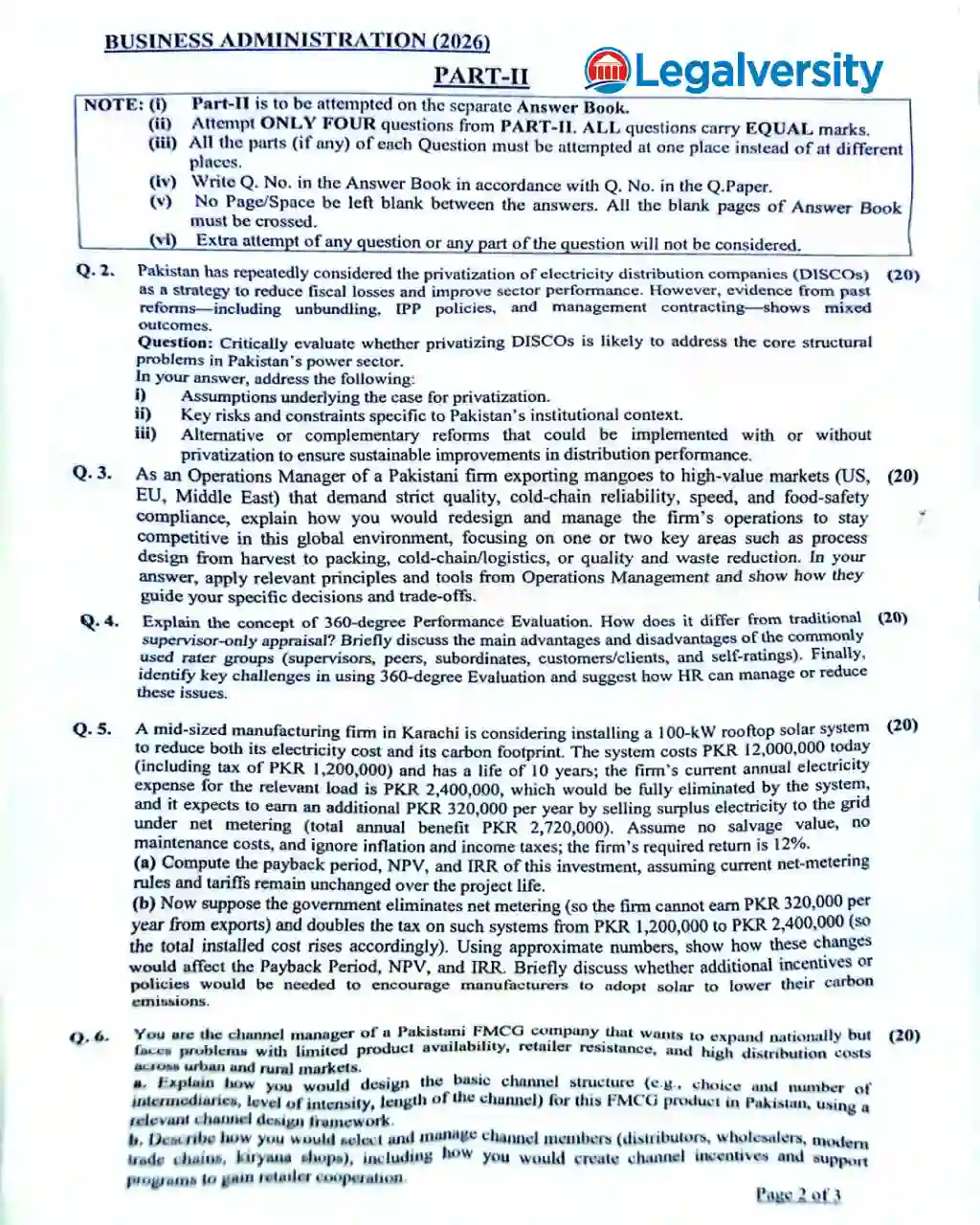
Q2. Pakistan has repeatedly considered the privatization of electricity distribution companies (DISCOs) as a strategy to reduce fiscal losses and improve sector performance. However, evidence from past reforms, including unbundling, IPP policies, and management contracting, shows mixed outcomes.
Question: Critically evaluate whether privatizing DISCOs is likely to address the core structural problems in Pakistan’s power sector.
In your answer, address the following:
i) Assumptions underlying the case for privatization.
ii) Key risks and constraints specific to Pakistan’s institutional context.
iii) Alternative or complementary reforms that could be implemented with or without privatization to ensure sustainable improvements in distribution performance.
Q3. As an Operations Manager of a Pakistani firm exporting mangoes to high-value markets (US, EU, Middle East) that demand strict quality, cold-chain reliability, speed, and food-safety compliance, explain how you would redesign and manage the firm’s operations to stay competitive in this global environment, focusing on one or two key areas such as process design from harvest to packing, cold-chain/logistics, or quality and waste reduction. In your answer, apply relevant principles and tools from Operations Management and show how they guide your specific decisions and trade-offs.
Q4. Explain the concept of 360-degree Performance Evaluation. How does it differ from traditional supervisor-only appraisal? Briefly discuss the main advantages and disadvantages of the commonly used rater groups (supervisors, peers, subordinates, customers/clients, and self-ratings). Finally, identify key challenges in using 360-degree Evaluation and suggest how HR can manage or reduce these issues.
Q5. A mid-sized manufacturing firm in Karachi is considering installing a 100-kW rooftop solar system to reduce both its electricity cost and its carbon footprint. The system costs PKR 12,000,000 today (including tax of PKR 1,200,000) and has a life of 10 years; the firm’s current annual electricity expense for the relevant load is PKR 2,400,000, which would be fully eliminated by the system, and it expects to earn an additional PKR 320,000 per year by selling surplus electricity to the grid under net metering (total annual benefit PKR 2,720,000). Assume no salvage value, no maintenance costs, and ignore inflation and income taxes; the firm’s required return is 12%.
(a) Compute the payback period, NPV, and IRR of this investment, assuming current net-metering rules and tariffs remain unchanged over the project life.
(b) Now suppose the government eliminates net metering (so the firm cannot earn PKR 320,000 per year from exports) and doubles the tax on such systems from PKR 1,200,000 to PKR 2,400,000 (so the total installed cost rises accordingly). Using approximate numbers, show how these changes would affect the Payback Period, NPV, and IRR. Briefly discuss whether additional incentives or policies would be needed to encourage manufacturers to adopt solar to lower their carbon emissions.
Q6. You are the channel manager of a Pakistani FMCG company that wants to expand nationally but faces problems with limited product availability, retailer resistance, and high distribution costs across urban and rural markets.
a. Explain how you would design the basic channel structure (e.g., choice and number of intermediaries, level of intensity, length of the channel) for this FMCG product in Pakistan, using a relevant channel design framework.
b. Describe how you would select and manage channel members (distributors, wholesalers, modern trade chains, kiryana shops), including how you would create channel incentives and support programs to gain retailer cooperation.
c. Using relevant Theories of Channel Power, Conflict, and Vertical Marketing Systems (VMS), explain how you would prevent and manage channel conflicts (e.g., between traditional retailers and modern trade, or between online and offline channels) in the Pakistani context.
d. Briefly explain how you would use technology and multi-channel/omni-channel strategies (e.g., B2B ordering apps, e-commerce platforms, logistics partnerships) to improve coverage, efficiency, and coordination in your distribution system.
Q7. You are the brand manager of a Pakistani FMCG company planning to launch a new national brand (e.g., tea, snack food, or personal-care product) in a highly competitive and price-sensitive market where many brands appear similar.
a. Explain how you would design the brand identity for this product, referring to a relevant Brand Identity Framework (such as Kapferer’s Brand Identity Prism or Aaker’s Brand Identity System).
b. Define the brand’s value proposition and positioning by clearly stating the target segment, frame of reference, point(s) of difference, and reason to believe. Apply relevant positioning concepts and illustrate your answer with Pakistan-specific examples.
c. Using either Keller’s Customer-Based Brand Equity (CBBE) model or Aaker’s Brand Equity dimensions (choose one), explain how your branding decisions would help build strong brand equity over time.
d. Briefly explain how the brand elements (name, logo, packaging, and slogan) would reinforce the intended positioning and appeal to Pakistani consumers.
Q8. You are the marketing manager of a Pakistani textile and apparel brand planning to launch a new clothing line for younger urban consumers in cities such as Karachi and Lahore.
a. Briefly identify and justify two or three key consumer segments within this younger urban market (e.g., by lifestyle, social class, or benefits sought).
b. For one chosen target segment, analyze two or three major influences on their buying behaviour (e.g., cultural values, reference groups, family, lifestyle, personality/self-concept) that are especially relevant in Pakistan.
c. Describe the main stages of the consumer buying-decision process for this clothing line and explain how you would try to influence the chosen segment at two or three of these stages.
d. For any two of your recommendations from parts (b) or (c), explicitly show how specific Consumer Behaviour Theories or Models (e.g., cultural/social/personal factors, buyer decision process model) guided your analysis and decisions.
View the CSS Business Administration Past Paper 2026: