
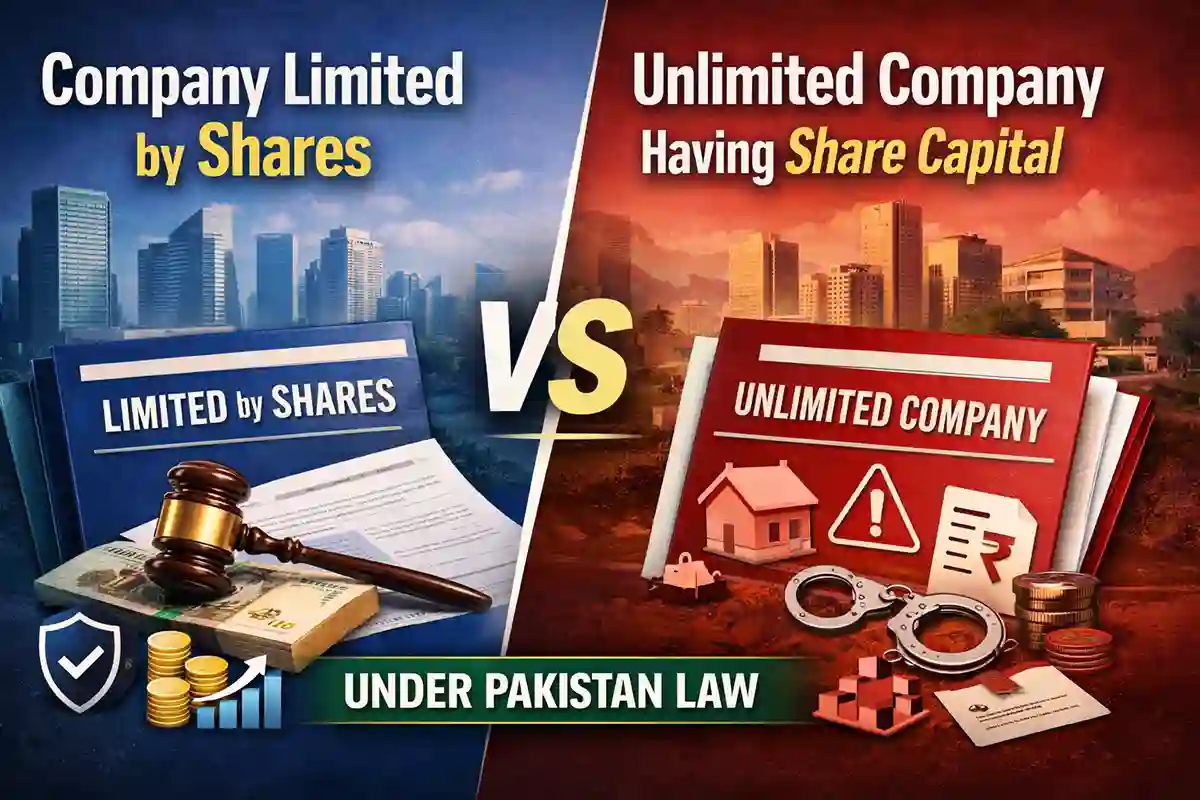
Executive Summary: Private/Public Companies Limited by Shares are the default and overwhelmingly preferred corporate form in Pakistan because they ring-fence members’ personal assets and are investor- and bank-friendly.
Unlimited companies having share capital are legally permissible under the Companies Act, 2017, but are rare in practice due to unlimited member liability and limited commercial acceptance.
In Pakistan, the share capital structure does not, in itself, determine reputation; liability allocation, governance, disclosure, and financing strategy do.
For startups, SMEs, and growth businesses, the clear recommendation is a company limited by shares, unless a very specific, specialist rationale justifies an unlimited company.
Introduction
Pakistani law offers multiple corporate forms: companies limited by shares, companies limited by guarantee, unlimited companies, and single-member companies, each serving different commercial objectives. Among these, the choice between a company limited by shares and an unlimited company having share capital directly affects risk allocation, financing, governance, and creditor exposure.
This distinction matters at formation and throughout the company’s lifecycle: when raising capital, onboarding directors or employees, entering financing arrangements, and critically, on winding up. This article compares the two forms through the lens of Pakistan’s Companies Act, 2017, SECP procedures, and prevailing market practice, with practical examples and checklists for founders and advisors.
Legal Definitions and Statutory Basis (Pakistan)
Companies Act, 2017 (Key Provisions)
Company limited by shares: A company where members’ liability is limited to the amount unpaid on their shares.
Statutory basis: Companies Act, 2017 (definitions in section 2; incorporation and liability framework under sections 4–6 and Part II).
Unlimited company (including one having share capital): A company where members’ liability is unlimited.
Statutory basis: Companies Act, 2017 (definitions in section 2; incorporation provisions under sections 4–6 and related Parts).
Note on section numbering: The Act consolidates definitions in section 2 and sets incorporation/liability concepts in early sections. Always verify the latest consolidated text on SECP’s website before filing.
SECP Framework and Forms
Incorporation filings are made electronically via SECP eServices.
- Form 1 – Application for incorporation
- Form 21 – Notice of registered office
- Form 29 – Particulars of directors/CEO (and changes)
- Memorandum & Articles of Association – Filed as part of incorporation
Learn more: How to register a trademark in Pakistan
Key Legal Differences (Side-by-Side)
Concise Comparison Table
| Feature | Company Limited by Shares | Unlimited Company Having Share Capital |
|---|---|---|
| Member liability | Limited to unpaid amount on shares | Unlimited; personal assets exposed |
| Share capital | Yes | Yes |
| Investor/bank acceptance | High | Low |
| Risk profile | Contained | High |
| Common usage in Pakistan | Very common | Very rare |
| Winding up exposure | Limited contribution | Limited to the unpaid amount on shares |
1) Liability of Members
- Limited by shares: Members’ exposure is capped at the unpaid portion of shares held. If shares are fully paid, no further liability arises in the event of insolvency.
- Unlimited with share capital: Members may be required to contribute without limit to satisfy company debts on winding up. This includes personal assets.
Practice note: This single difference drives most commercial decisions. Creditors may perceive unlimited companies as offering deeper recourse, but banks still prefer limited companies due to governance and predictability.
Both forms may have authorized and paid-up share capital. In Pakistan, the face value of shares (e.g., PKR 10 per share) is a drafting choice and does not, by itself, signal quality.
- Limited companies often issue low-face-value shares to enable flexibility in future issuances.
- Unlimited companies can also issue shares, but the liability overlay changes the risk calculus.
3) Memorandum & Articles / Constitution
- Limited by shares: The memorandum must clearly state that liability is limited.
- Unlimited company: The memorandum states that liability is unlimited, even if share capital exists.
Articles typically cover share transfers, board powers, quorum, and reserved matters. For private companies, transfer restrictions are standard.
4) Formation and Registration (SECP)
The procedural steps are broadly similar:
- Name availability (SECP eServices)
- File Form 1 with Memorandum & Articles
- File Form 21 (registered office)
- File Form 29 (directors/CEO)
- Pay statutory fees; obtain Certificate of Incorporation
Special requirements: No separate SECP approval is required merely because a company is unlimited; however, clear disclosure in its constitutional documents is essential.
- Limited by shares (private): Articles usually restrict transfers (right of first refusal, board approval).
- Unlimited: Similar mechanics may apply, but incoming members must appreciate unlimited liability, which materially affects transferability in practice.
6) Directors’ Duties and Governance
Directors’ fiduciary and statutory duties under the Companies Act, 2017, apply equally to both forms. Governance quality, not the share face value, drives compliance outcomes.
7) Winding Up and Creditors’ Rights
- Limited by shares: Creditors rely on company assets; members contribute only unpaid share capital.
- Unlimited: On winding up, members may be called upon personally to meet deficits.
8) Ability to Raise Capital; Investor Perceptions
- Limited by shares: Preferred by angels, VCs, PE funds, and banks. Enables ESOPs and staged financing.
- Unlimited: Typically unacceptable to institutional investors; ESOPs are impractical due to liability exposure.
9) Tax and Regulatory Consequences (Pakistan)
- Income tax: Corporate income tax treatment under the Income Tax Ordinance, 2001, generally depends on the company’s status, not on the liability type.
- Withholding, sales tax: Similarly neutral to liability form.
Tax caveat: This is a general practice note, not tax advice. Specific structures may produce different outcomes; consult a tax advisor.
Practical Implications and Examples
Scenario 1: Investor-Funded Startup
A tech startup plans angel funding and an ESOP.
Choice: Company limited by shares.
Why: Limited liability, clean cap table, investor familiarity.
Scenario 2: Family-Controlled Asset-Holding Vehicle
A closely held family business with high trust and minimal external borrowing.
Choice: Usually limited by shares.
Why: Unlimited adds risk without commercial upside.
Scenario 3: High-Risk Trading Business
Commodity trading with significant credit exposure
Choice: Limited by shares (strongly)
Why: Ring-fencing risk is critical
Read more: How to submit the Zakat declaration form in Banks
Advantages and Disadvantages
Pros
- Limited liability protection
- Investor and bank-friendly
- Flexible capital structuring
- ESOP-compatible
Cons
- Ongoing compliance costs
- Disclosure and governance obligations
Pros
- Theoretical creditor comfort
- Simple concept in closely trusted groups
Cons
- Unlimited personal liability
- Poor market acceptance
- Difficult to transfer shares or raise funds
Checklist for Choosing the Right Form (Pakistan)
- What is the risk profile of the business?
- Will you seek external investors or bank finance?
- Do founders accept personal asset exposure?
- Is an ESOP or staged funding planned?
- Are there regulatory or lender preferences?
- What is the exit strategy?
Practical Steps and Sample Clauses
Incorporation Checklist (SECP)
- Decide company type and name
- Draft Memorandum & Articles
- File Form 1, Form 21, Form 29
- Pay fees; obtain incorporation certificate
- Issue share certificates; update statutory registers
Sample Memorandum Clause (Liability)
- Limited by Shares:
The liability of the members is limited to the amount, if any, unpaid on the shares respectively held by them. - Unlimited Company:
The members’ liability is unlimited.
No shares shall be transferred to any person unless the same have first been offered to existing members pro rata at a price determined by the Board, and the Board has approved such transfer.
Conclusion and Recommendations
In Pakistan, the company limited by shares is the commercially sensible default for almost all businesses—startups, SMEs, and growth companies alike. It balances flexibility, governance, and risk containment, and aligns with SECP practice, investor expectations, and banking requirements.
Unlimited companies having share capital remain a legal option, but are rarely advisable. Their unlimited liability offers little practical benefit while creating significant personal risk and financing obstacles.
Final advice: Choose a private limited company by shares unless you have a specific, well-advised reason documented and understood by all stakeholders to do otherwise.
References and Further Reading
- Companies Act, 2017 (SECP): https://www.secp.gov.pk/document/companies-act-2017
- SECP eServices & Forms: https://eservices.secp.gov.pk
- Income Tax Ordinance, 2001 (FBR): https://www.fbr.gov.pk
- SECP Circulars and FAQs on incorporation and share capital (SECP website)
