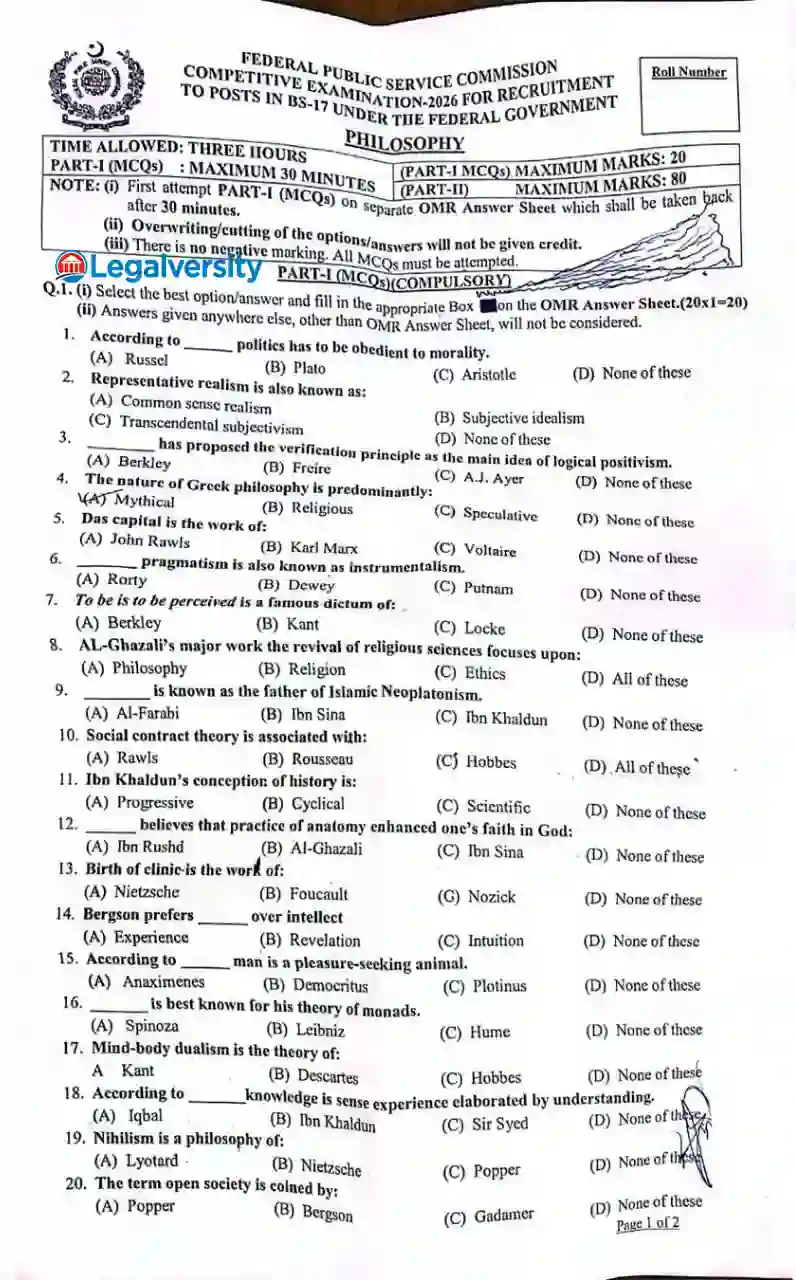
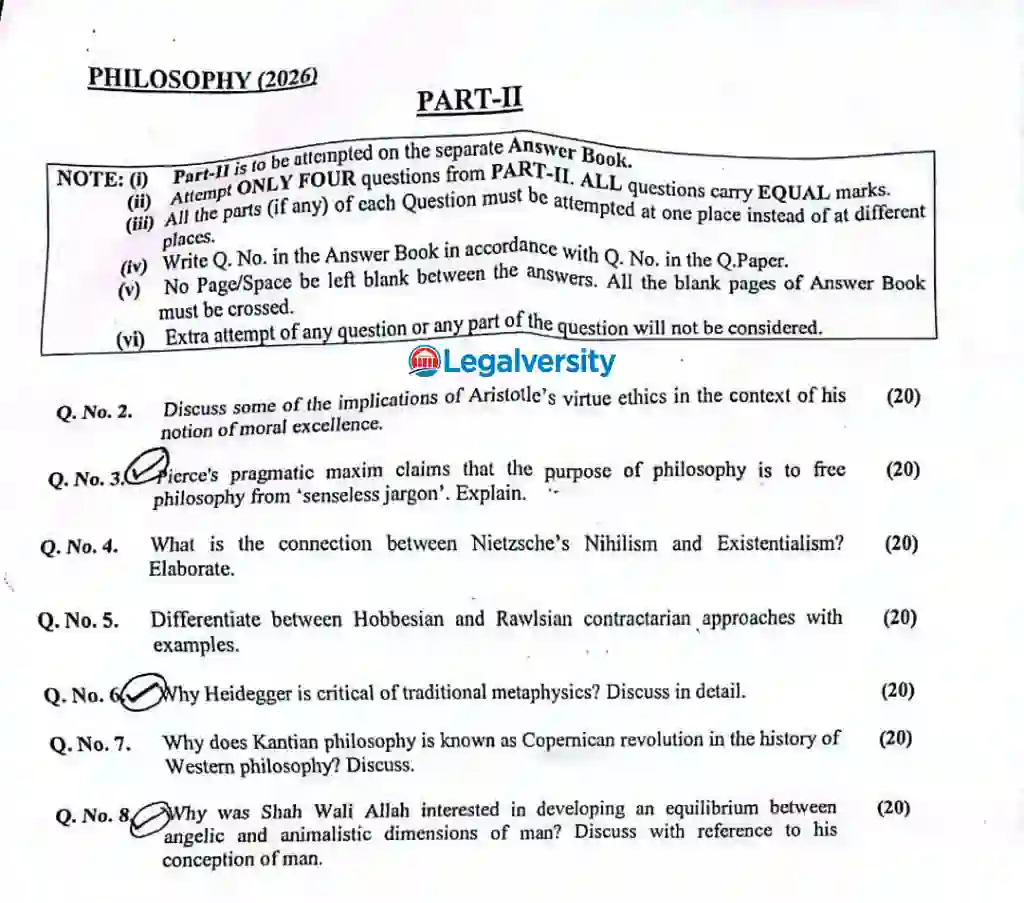
The CSS Philosophy Paper 2026 is an optional subject that examines a candidate’s understanding of major philosophical traditions, thinkers, and debates ranging from classical Greek philosophy to modern and contemporary thought. The paper reflects the depth and analytical rigor of philosophy by testing concepts related to metaphysics, epistemology, ethics, political philosophy, and logic.
It requires not only conceptual clarity but also the ability to critically evaluate arguments, compare philosophical positions, and construct coherent reasoning. Here you will find the CSS Philosophy past paper for 2026, providing insight into the paper’s structure, thematic emphasis, and the intellectual depth expected from serious aspirants.
CSS Philosophy Past Paper 2026
Q. No. 2: Critically analyze the emergence and development of Sociology, emphasizing the transformative role of the Industrial and French Revolutions. Evaluate how these historical contexts influenced the scientific study of society and the formation of key sociological perspectives.
Q. No. 3: Evaluate culture as a system of meanings embedded in social power structures. Discuss the elements of culture and assess how cultural lag and cultural relativism simultaneously facilitate social adaptation and generate moral conflicts in contemporary societies.
Q. No. 4: Analyze the transformation of Pakistani society from a traditional agrarian structure to a semi-industrial and post-industrial model. Highlight contradictions and structural challenges.
Q. No. 5: Explain the role of family and education as agents of social control in Pakistan. How have globalization and digital media altered their traditional functions?
Q. No. 6: Examine deviance and crime using classical and contemporary sociological theories such as Durkheim’s Anomie, Merton’s Strain Theory, and Labeling Theory. Critically evaluate the effectiveness of formal and informal social control mechanisms in regulating deviant behavior, considering applied contexts like cybercrime, youth delinquency, and social inequality.
Q. No. 7: Define collective behavior and public opinion, and critically assess their dynamics in modern societies. Discuss how phenomena such as crowds, mobs, rumors, social movements, and mass media shape public perception and social action.
Q. No. 8: Discuss the major factors driving social and cultural change, including technological, demographic, educational, and economic forces. Critically analyze how globalization has transformed cultural practices, social norms, and identities in Pakistan, with applied examples.
Read more: All CSS Past Papers
View the CSS Philosophy past paper 2026: