
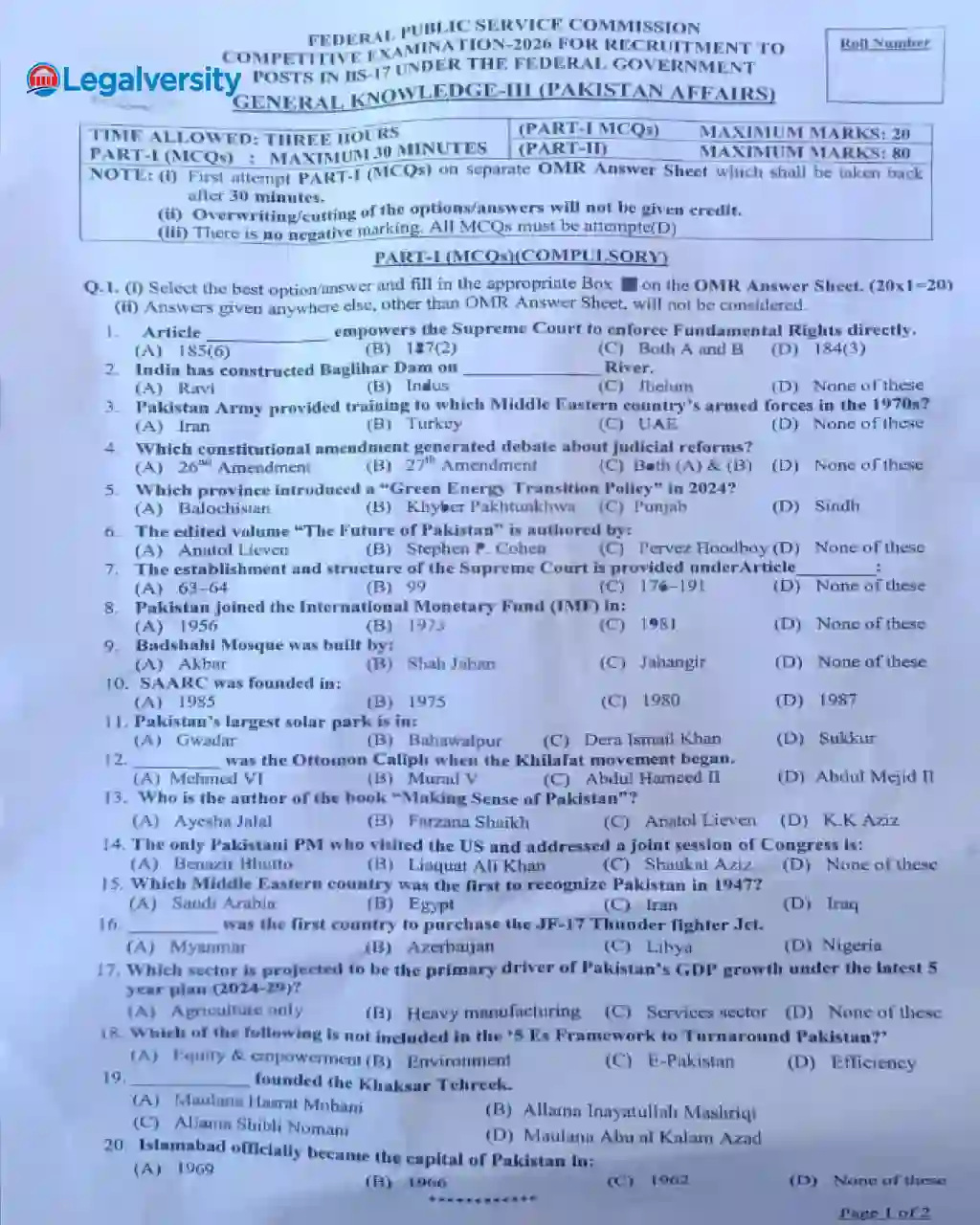
The CSS Pakistan Affairs Paper 2026 is a compulsory paper that tests a candidate’s understanding of Pakistan’s ideological foundations, constitutional development, internal and external challenges, and contemporary policy issues. Here you will find the CSS Pakistan Affairs past paper 2026. I have also provided a critical overview of the questions asked in the examination. Before moving on to the questions, this introduction highlights the paper’s major themes, the required analytical depth, and the overall difficulty level, helping aspirants understand what the FPSC expects in terms of argument-building, critical thinking, and Pakistan-centric analysis.
CSS Pakistan Affairs Past Paper 2026
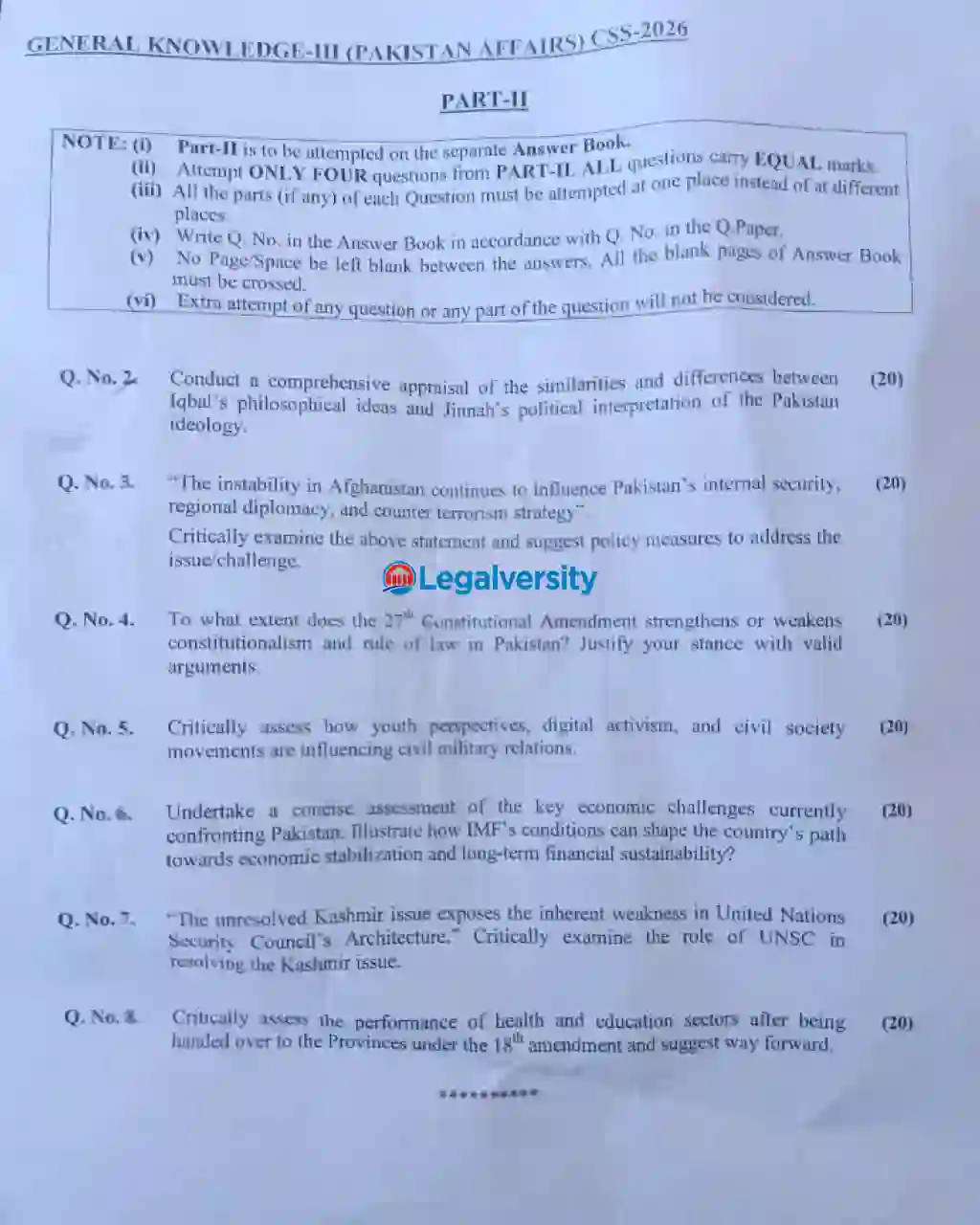
Q2. Conduct a comprehensive appraisal of the similarities and differences between Iqbal’s philosophical ideas and Jinnah’s political interpretation of the Pakistan ideology.
Q3. “The instability in Afghanistan continues to influence Pakistan’s internal security, regional diplomacy, and counter terrorism strategy”. Critically examine the above statement and suggest policy measures to address the issue/challenge.
Q4. To what extent does the 27th Constitutional Amendment strengthens or weakens constitutionalism and rule of law in Pakistan? Justify your stance with valid arguments.
Q.5 Critically assess how youth perspectives, digital activism, and civil society movements are influencing civil-military relations.
Q6. Undertake a concise assessment of the key economic challenges currently confronting Pakistan. Illustrate how the IMF’s conditions can shape the country’s path towards economic stabilization and long-term financial sustainability?
Q7. “The unresolved Kashmir issue exposes the inherent weakness in the United Nations Security Council’s Architecture.” Critically examine the role of the UNSC in resolving the Kashmir issue.
Q8. Critically assess the performance of the health and education sectors after being handed over to the Provinces under the 18th amendment and suggest a way forward.
Overall Impression of the Paper
The CSS Pakistan Affairs Paper 2026 was analytical, contemporary, and policy-oriented. FPSC clearly moved away from purely narrative or historical questions and focused instead on constitutional developments, internal governance issues, regional security dynamics, and economic challenges. The paper tested whether candidates could think like policy analysts rather than historians.
Overall, the paper can be categorized as moderate to tough, not because the topics were unfamiliar, but because each question demanded depth, balance, and evidence-based arguments.
Nature and Trend of Questions
The paper followed a clear modern CSS trend:
- Heavy focus on critical examination rather than description
- Strong linkage between theory and current realities
- Emphasis on constitutionalism, governance, and state institutions
- Clear expectation of Pakistan-specific context backed by facts
Almost every question required:
- Clear stance
- Logical argumentation
- Recent examples or developments
- Practical policy suggestions
Difficulty Level
- Conceptual understanding: Moderate
- Analytical depth required: High
- Factual recall alone: Not sufficient
Candidates with rote-learning preparation would struggle, while those who followed current affairs, constitutional developments, and policy debates had a clear advantage.
Question-wise Critical Breakdown & Scoring Potential
Q2. Iqbal’s Philosophy vs Jinnah’s Political Thought
Scoring Potential: High
This was a classical yet analytical question. Aspirants who clearly differentiated:
- Iqbal as a philosopher and ideologue
- Jinnah as a constitutional lawyer and political realist
could score well. The question rewarded structured comparison, quotations, and ideological clarity. It was especially beneficial for candidates with a strong grasp of Pakistan’s ideological foundations.
Risk: Turning it into a purely historical narrative without analysis.
Q3. Afghanistan’s Instability and Its Impact on Pakistan
Scoring Potential: Very High
This was one of the most scoring questions of the paper. It allowed candidates to:
- Link regional security with internal challenges
- Discuss terrorism, border management, refugees, and diplomacy
- Suggest realistic policy measures
Candidates who draw on current developments, regional geopolitics, and security policies could easily stand out.
Q4. 27th Constitutional Amendment and Rule of Law
Scoring Potential: Moderate to High
This was a tricky but rewarding question. It required:
- Clear understanding of constitutional amendments
- Balanced arguments (strengthening vs weakening constitutionalism)
- Legal and political reasoning
Those with weak constitutional knowledge likely avoided it, but well-prepared candidates could score well by maintaining neutrality and logic.
Q5. Youth, Digital Activism & Civil-Military Relations
Scoring Potential: Moderate
This was an unconventional and sensitive topic. While interesting, it required careful wording and balance. It tested:
- Sociopolitical awareness
- Understanding of civil-military dynamics
- Analytical maturity
Risk: Emotional or opinion-based writing could reduce marks.
Q6. Economic Challenges & IMF Conditionalities
Scoring Potential: Very High
This was another high-scoring question. It allowed:
- Discussion on fiscal deficit, debt, inflation, and structural issues
- Objective analysis of IMF programs
- Long-term economic sustainability
Candidates who used data, recent IMF programs, and economic reforms had a strong edge.
Q7. Kashmir Issue & UNSC’s Structural Weakness
Scoring Potential: High
A classic Pakistan Affairs question, but framed analytically. It tested:
- Understanding of international law
- UNSC structure and veto politics
- Pakistan’s diplomatic challenges
Balanced criticism of the UNSC, supported by historical context, could fetch good marks.
Q8. Health & Education After the 18th Amendment
Scoring Potential: Very High
This was one of the best-scoring and safest questions in the paper. It offered:
- Clear policy analysis
- Federal vs provincial governance debate
- Practical recommendations
Candidates who linked governance capacity, funding issues, and service delivery outcomes performed well.
What FPSC Was Actually Testing
FPSC was not testing:
- Lengthy historical storytelling
- Emotional nationalism
- Opinionated writing
Instead, it was testing:
- Policy thinking
- Balanced analysis
- Contemporary awareness
- Ability to propose realistic solutions
How to Score High in Pakistan Affairs
To score well in such a paper, aspirants should:
- Stick to structured answers
- Use headings and sub-headings
- Support arguments with facts and recent examples
- Avoid extreme or biased views
- Always end with a clear way forward
View the CSS Pakistan Affairs Past Paper 2026:
Also Read:
