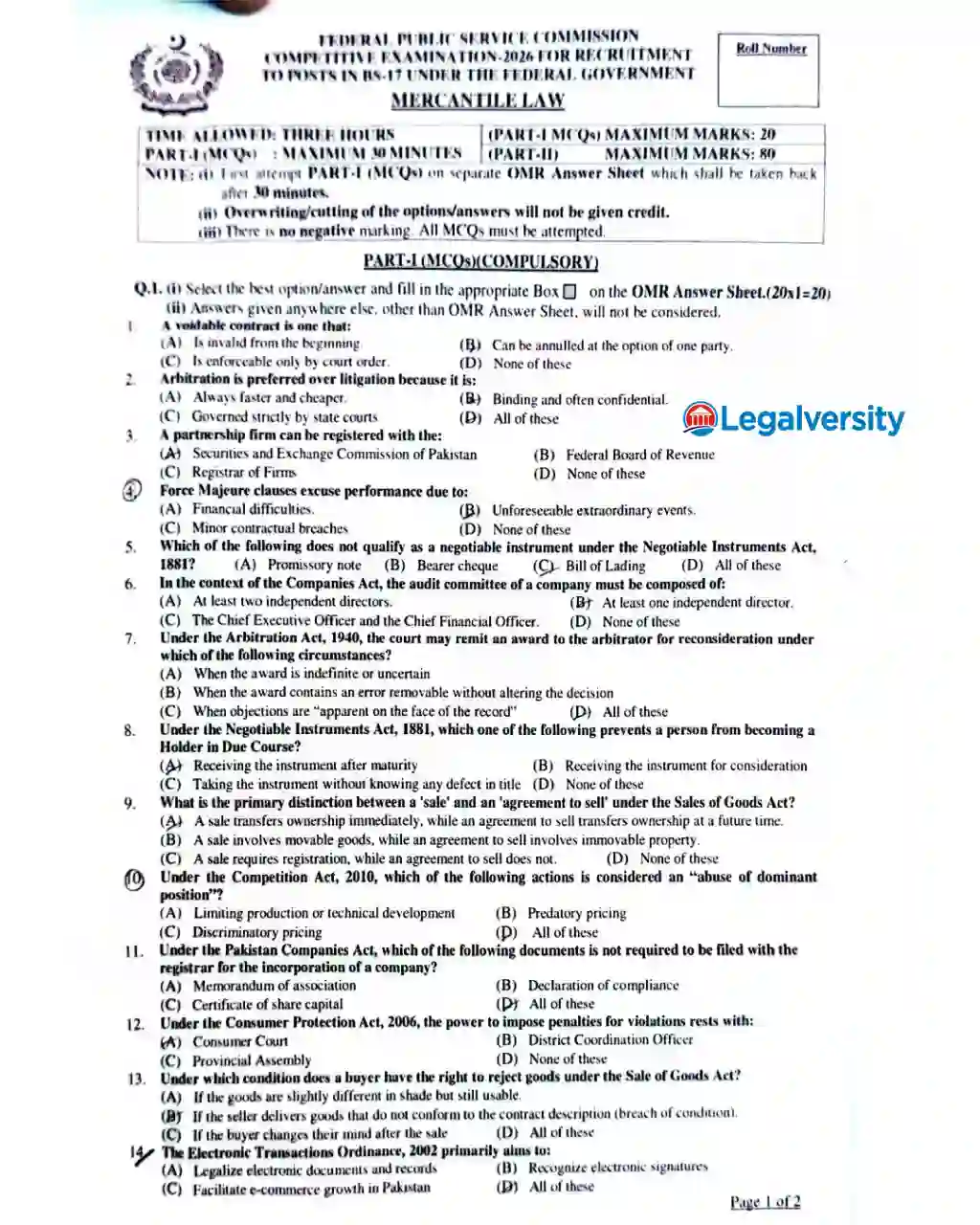
The CSS Mercantile Law Paper 2026 is an optional subject that assesses a candidate’s understanding of commercial and business law, including contracts, company law, partnership, sale of goods, negotiable instruments, and banking regulations. The paper reflects the practical and legal aspects of commerce, emphasizing not only the knowledge of statutory provisions but also the ability to apply legal principles to real-world business scenarios.
Candidates are expected to demonstrate clarity of concepts, analytical reasoning, and an understanding of how mercantile law impacts trade, commerce, and economic activities. Here you will find the CSS Mercantile Law past paper for 2026, providing insight into the paper’s structure and the level of preparation required for success.
CSS Mercantile Law Past Paper 2026
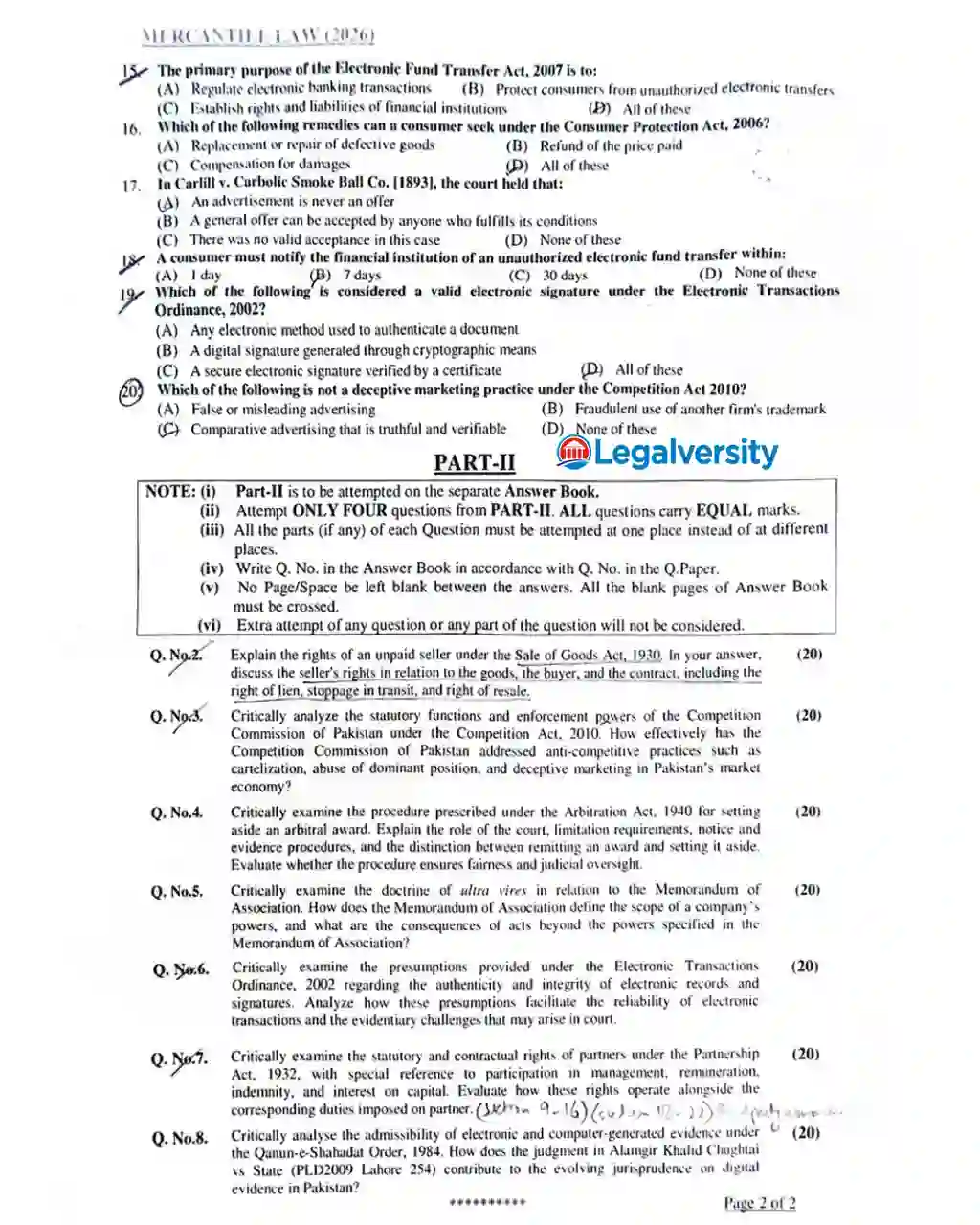
Q. No. 2. Explain the rights of an unpaid seller under the Sale of Goods Act, 1930. In your answer, discuss the seller’s rights in relation to the goods, the buyer, and the contract, including the right of lien, stoppage in transit, and right of resale.
Q. No. 3. Critically analyze the statutory functions and enforcement powers of the Competition Commission of Pakistan under the Competition Act, 2010. How effectively has the Competition Commission of Pakistan addressed anti-competitive practices such as cartelization, abuse of dominant position, and deceptive marketing in Pakistan’s market economy?
Q. No. 4. Critically examine the procedure prescribed under the Arbitration Act, 1940, for setting aside an arbitral award. Explain the role of the court, limitation requirements, notice and evidence procedures, and the distinction between remitting an award and setting it aside. Evaluate whether the procedure ensures fairness and judicial oversight.
Q. No. 5. Critically examine the doctrine of ultra vires in relation to the Memorandum of Association. How does the Memorandum of Association define the scope of a company’s powers, and what are the consequences of acts beyond the powers specified in the Memorandum of Association?
Q. No. 6. Critically examine the presumptions provided under the Electronic Transactions Ordinance, 2002, regarding the authenticity and integrity of electronic records and signatures. Analyze how these presumptions facilitate the reliability of electronic transactions and the evidentiary challenges that may arise in court.
Q. No. 7. Critically examine the statutory and contractual rights of partners under the Partnership Act, 1932, with special reference to participation in management, remuneration, indemnity, and interest on capital. Evaluate how these rights operate alongside the corresponding duties imposed on the partner.
Q. No. 8. Critically analyse the admissibility of electronic and computer-generated evidence under the Qanun-e-Shahadat Order, 1984. How does the judgment in Alamgir Khalid Chughtai vs State (PLD2009 Lahore 254) contribute to the evolving jurisprudence on digital evidence in Pakistan?
Read more: MCQs of Mercantile Law