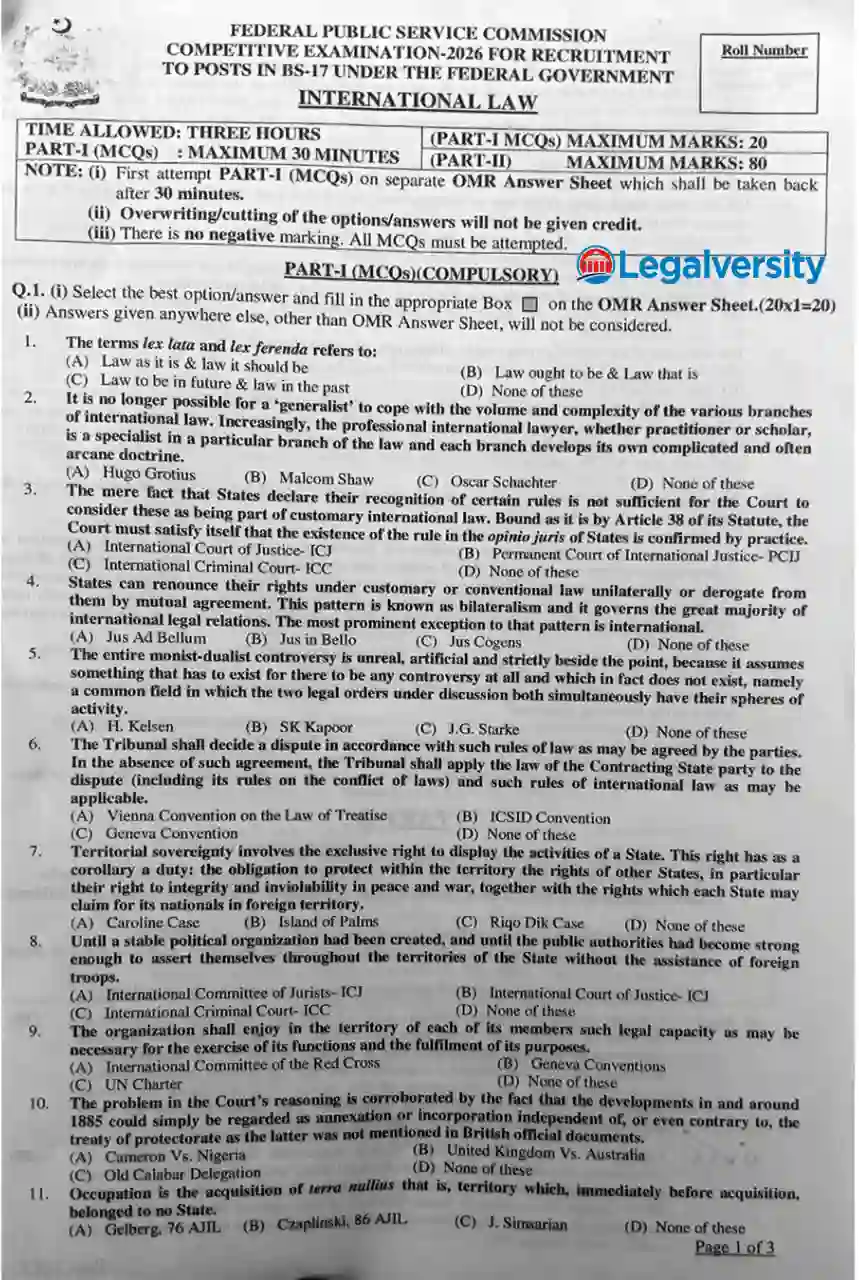
The CSS International Law Paper 2026 is an optional subject that examines a candidate’s understanding of the principles, sources, and evolving dynamics of public international law. The paper reflects the growing importance of legal frameworks governing state conduct, human rights, armed conflict, treaties, maritime law, and international dispute resolution.
This paper requires not only knowledge of legal doctrines and conventions but also the ability to critically analyze contemporary global issues within a legal context. Here you will find the CSS International Law past paper for 2026, providing insight into the paper’s structure, thematic focus, and the analytical rigor expected from aspirants.
CSS International Law Past Paper 2026
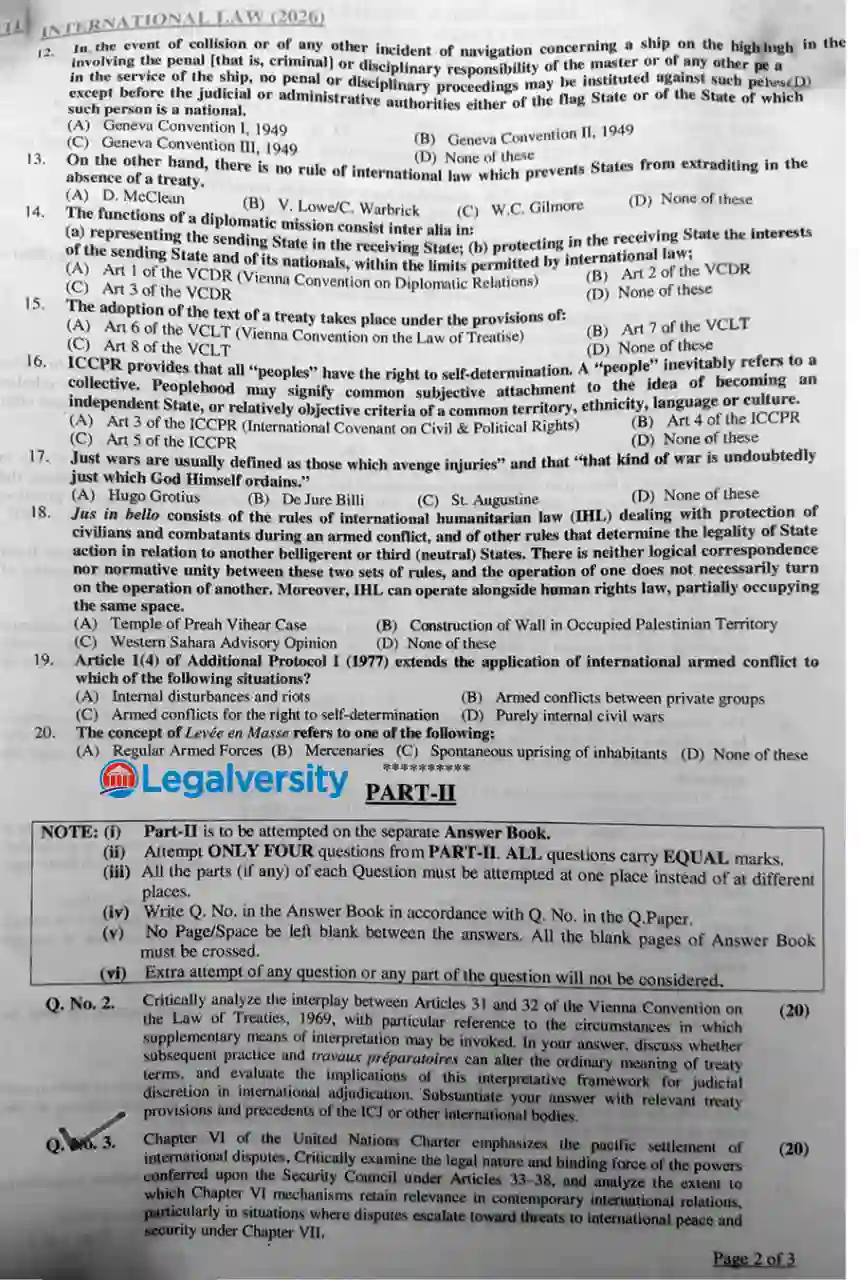
Q. No. 2. Critically analyze the interplay between Articles 31 and 32 of the Vienna Convention on the Law of Treaties, 1969, with particular reference to the circumstances in which supplementary means of interpretation may be invoked. In your answer, discuss whether subsequent practice and travaux préparatoires can alter the ordinary meaning of treaty terms, and evaluate the implications of this interpretative framework for judicial discretion in international adjudication. Substantiate your answer with relevant treaty provisions and precedents of the ICJ or other international bodies.
Q. No. 3. Chapter VI of the United Nations Charter emphasizes the pacific settlement of international disputes. Critically examine the legal nature and binding force of the powers conferred upon the Security Council under Articles 33–38, and analyze the extent to which Chapter VI mechanisms retain relevance in contemporary international relations, particularly in situations where disputes escalate toward threats to international peace and security under Chapter VII.
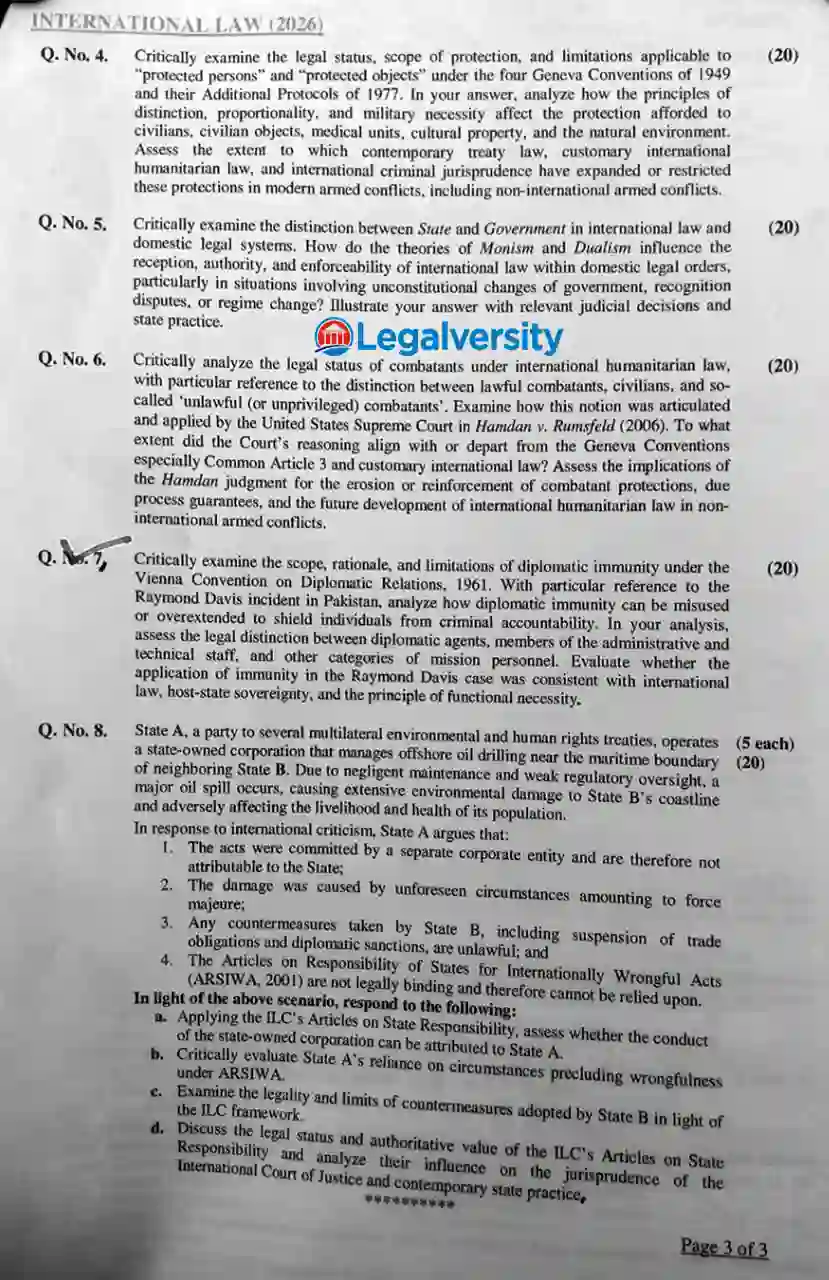
Q. No. 4. Critically examine the legal status, scope of protection, and limitations applicable to “protected persons” and “protected objects” under the four Geneva Conventions of 1949 and their Additional Protocols of 1977. In your answer, analyze how the principles of distinction, proportionality, and military necessity affect the protection afforded to civilians, civilian objects, medical units, cultural property, and the natural environment. Assess the extent to which contemporary treaty law, customary international humanitarian law, and international criminal jurisprudence have expanded or restricted these protections in modern armed conflicts, including non-international armed conflicts.
Q. No. 5. Critically examine the distinction between State and Government in international law and domestic legal systems. How do the theories of Monism and Dualism influence the reception, authority, and enforceability of international law within domestic legal orders, particularly in situations involving unconstitutional changes of government, recognition disputes, or regime change? Illustrate your answer with relevant judicial decisions and state practice.
Q. No. 6. Critically analyze the legal status of combatants under international humanitarian law, with particular reference to the distinction between lawful combatants, civilians, and so-called ‘unlawful (or unprivileged) combatants’. Examine how this notion was articulated and applied by the United States Supreme Court in Hamdan v. Rumsfeld (2006). To what extent did the Court’s reasoning align with or depart from the Geneva Conventions, especially Common Article 3 and customary international law? Assess the implications of the Hamdan judgment for the erosion or reinforcement of combatant protections, due process guarantees, and the future development of international humanitarian law in non-international armed conflicts.
Q. No. 7. Critically examine the scope, rationale, and limitations of diplomatic immunity under the Vienna Convention on Diplomatic Relations, 1961. With particular reference to the Raymond Davis incident in Pakistan, analyze how diplomatic immunity can be misused or overextended to shield individuals from criminal accountability. In your analysis, assess the legal distinction between diplomatic agents, members of the administrative and technical staff, and other categories of mission personnel. Evaluate whether the application of immunity in the Raymond Davis case was consistent with international law, host-state sovereignty, and the principle of functional necessity.
Q. No. 8. State A, a party to several multilateral environmental and human rights treaties, operates a state-owned corporation that manages offshore oil drilling near the maritime boundary of neighboring State B. Due to negligent maintenance and weak regulatory oversight, a major oil spill occurs, causing extensive environmental damage to State B’s coastline and adversely affecting the livelihood and health of its population.
View the CSS International Law Past Paper 2026: