
The CSS Geography Paper 2026 is an optional paper that examines a candidate’s understanding of both physical and human geography, linking natural processes with human activities and global developments. The paper reflects the interdisciplinary nature of geography by covering themes such as climate systems, geomorphology, population dynamics, urbanization, economic geography, and regional planning.
It evaluates not only theoretical knowledge but also the ability to interpret maps, diagrams, data trends, and contemporary geographical issues in a structured and analytical manner. Overall, the paper demands clarity of concepts, strong analytical skills, and the capacity to connect geographical theory with real-world challenges at national and global levels.
CSS Geography Past Paper 2026
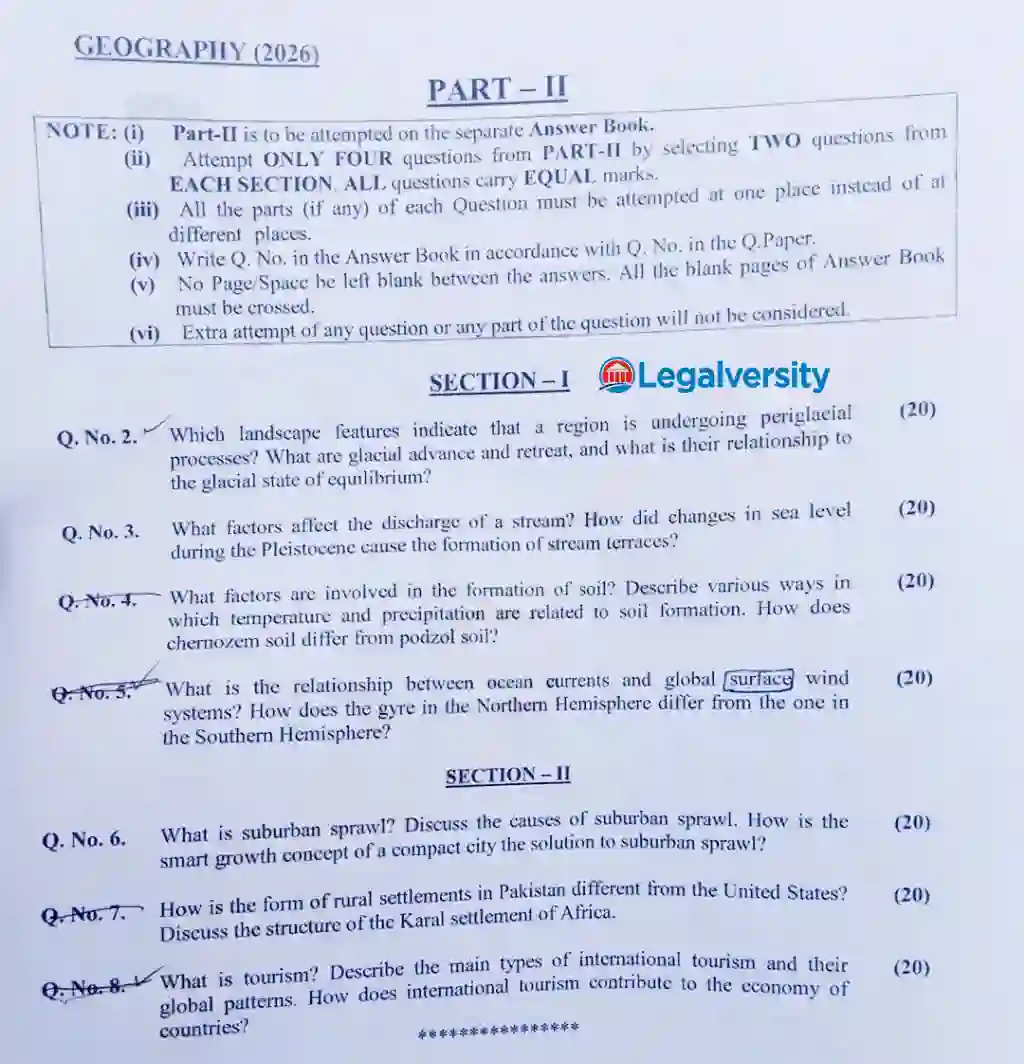
SECTION – I
Q2. Which landscape features indicate that a region is undergoing periglacial processes? What are glacial advances and retreats, and what is their relationship to the glacial state of equilibrium?
Q3. What factors affect the discharge of a stream? How did changes in sea level during the Pleistocene cause the formation of stream terraces?
Q4. What factors are involved in the formation of soil? Describe various ways in which temperature and precipitation are related to soil formation. How does chernozem soil differ from podzol soil?
Q5. What is the relationship between ocean currents and global surface wind systems? How does the gyre in the Northern Hemisphere differ from the one in the Southern Hemisphere?
SECTION – II
Q6. What is suburban sprawl? Discuss the causes of suburban sprawl. How is the smart growth concept of a compact city the solution to suburban sprawl?
Q7. How is the form of rural settlements in Pakistan different from the United States? Discuss the structure of the Karal settlement of Africa.
Q8. What is tourism? Describe the main types of international tourism and their global patterns. How does international tourism contribute to the economy of countries?
View Geography past paper 2026:
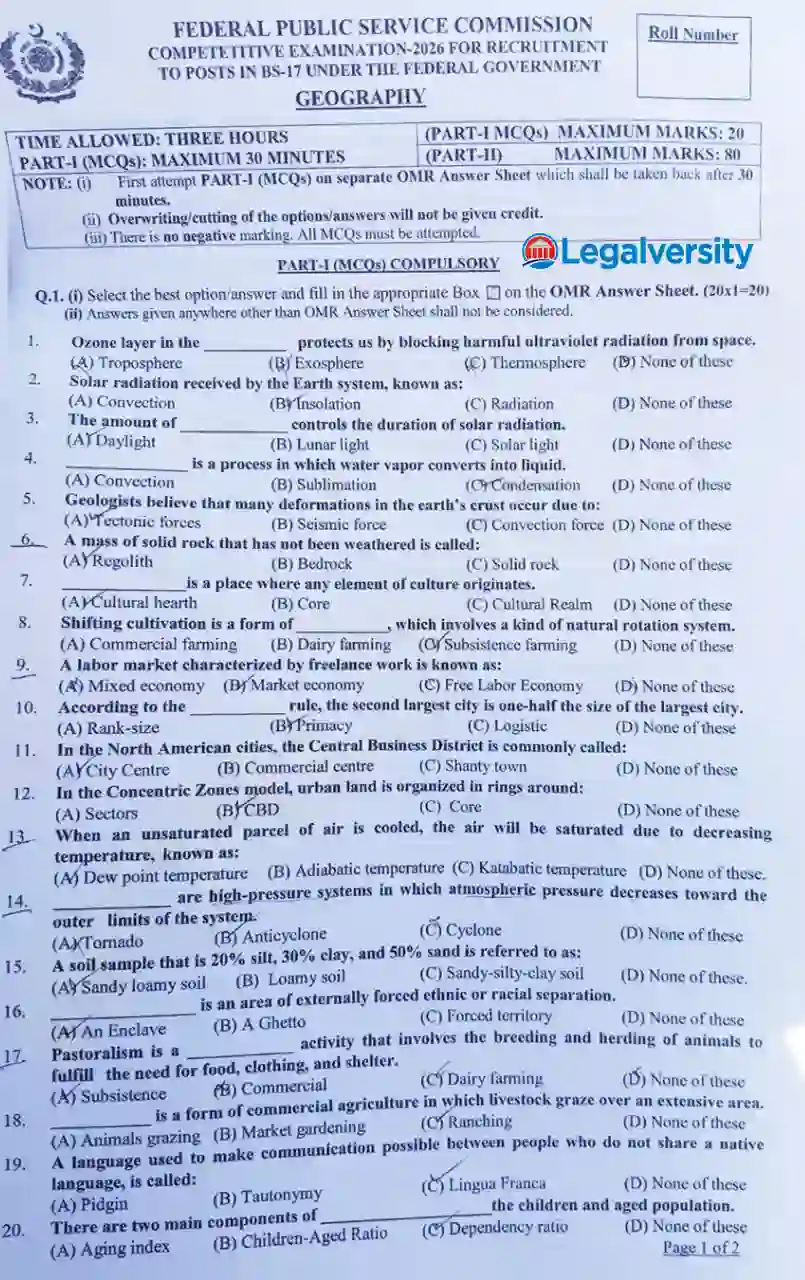
Critical Analysis of CSS Geography Paper 2026
The CSS Geography Paper 2026 tested candidates on a blend of physical and human geography, with a strong emphasis on conceptual understanding, analytical reasoning, and real-world applications. The paper was well-balanced, with Section-I focusing on physical geography processes and Section-II focusing on human and applied geography, ensuring that aspirants were evaluated on both theory and its practical implications.
Section-Wise Analysis
SECTION I – Physical Geography
Q2 – Periglacial Processes & Glacial Equilibrium
- Tested knowledge of periglacial landforms, glacial advances and retreats, and equilibrium concepts.
- Scoring depended on the ability to label diagrams, explain processes logically, and link glacial movements to climate fluctuations.
- Moderate difficulty for well-prepared candidates.
Q3 – Stream Discharge & Pleistocene Sea Level Changes
- Combined hydrology with geological history.
- Candidates had to explain stream flow factors and link sea-level changes to terrace formation.
- High scoring if diagrams and step-by-step explanation were included.
Q4 – Soil Formation & Types
- Tested pedology fundamentals: soil formation factors, climate-soil relationships, and comparative analysis (chernozem vs podzol).
- Moderate difficulty; scoring was high for clear, structured answers with examples and diagrams.
Q5 – Ocean Currents & Wind Systems
- Required understanding of climate system dynamics and oceanography.
- High scoring if candidates explained gyres, the Coriolis effect, and hemispherical differences, with diagrams.
SECTION II – Human & Applied Geography
Q6 – Suburban Sprawl & Smart Growth
- Tested urban geography and planning concepts.
- Candidates needed to define suburban sprawl, identify causes, and explain compact city solutions.
- Very scoring if examples of cities were included.
Q7 – Rural Settlement Patterns
- Compared Pakistan, the US, and African rural settlements.
- Candidates could score high by describing settlement forms, functions, and spatial patterns, supported by examples.
Q8 – Tourism & Global Patterns
- Focused on economic geography and applied geography.
- Candidates needed to describe tourism types, patterns, and economic impacts globally.
- Moderate difficulty; high scoring if explanations were precise and data-driven examples were included.
Strengths of the Paper
- Balanced coverage of physical and human geography.
- Encouraged diagram use and analytical thinking.
- Applied questions like tourism economics and urban planning tested real-world understanding.
- Pakistan-specific examples (rural settlements) favored local context knowledge.
Challenges & Areas of Focus for High Scores
- Diagrams and labeling: Nearly all physical geography questions required clear visuals.
- Linking processes to outcomes: High scoring depended on causal explanations, not just definitions.
- Applied knowledge: Questions on urban sprawl, smart cities, and tourism demanded awareness of practical examples.
- Comparative analysis: Soil types, gyres, and settlements required comparisons and distinctions, not just descriptions.
- Integration of theory and examples: Especially for questions like Q3 (Pleistocene terraces) and Q5 (wind-ocean systems).
Conclusion
The CSS Geography Paper 2026 was well-structured and balanced, rewarding candidates who could combine conceptual clarity, diagrammatic skill, and applied understanding. It favored aspirants who prepared both physical processes and human geography trends, particularly those who could link theory with examples, comparisons, and real-world impacts.
