
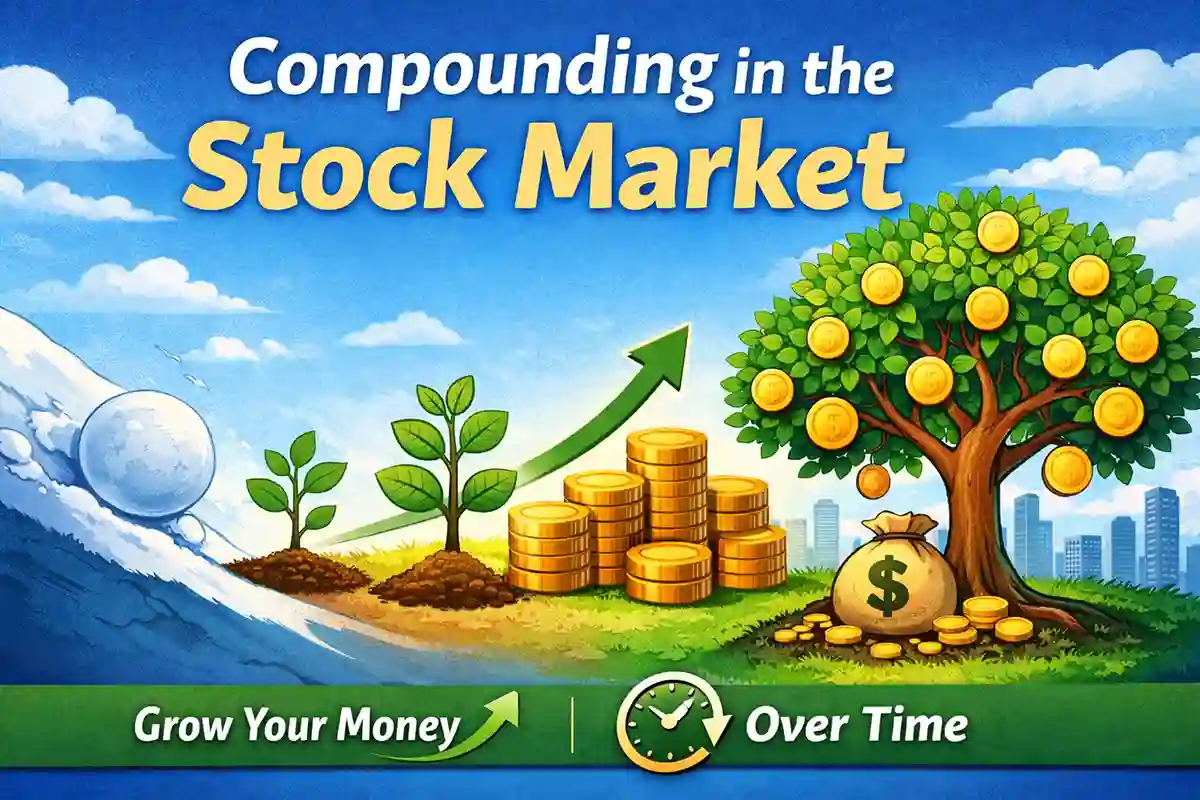
Imagine planting one tiny seed. At first, it’s just a small sprout. But season by season, year by year, it grows, first into a tree, then a whole forest of shade and fruit. That’s what compounding does to your money. It takes something small and, given time, turns it into something wonderfully large. Here I am going to share with you how to do compounding in the stock market.
In the world of saving and investing, compounding is the quiet engine that makes wealth grow in the background while you sleep, study, or work. It’s not about luck or magic. It’s about patience and consistency.
What Is Compounding?
Compounding means earning money on both your original amount and on the money that your investment has already earned. It’s “growth on growth.”
In the stock market, compounding happens in two main ways:
Dividends are the cash payments companies give their shareholders, often from profits. When you reinvest those dividends, that is, use them to buy more shares, you start earning money on your past earnings.
Price appreciation means your shares themselves rise in value. If you bought a share at $100 (PKR 28,000) and it climbed to $120 (PKR 33,600), you gained $20 (PKR 5,600) per share. If you keep holding rather than selling, that gain can itself grow more over time.
Together, dividends and price appreciation create compounding. The more you reinvest and stay invested, the more powerful it becomes.
How Compounding Works
Compounding means each period’s return joins your total balance before calculating the next return. The formula looks like this:
A = P(1 + r)t
- A = the final amount after t years
- P = the starting amount (your principal)
- r = the annual return rate (as a decimal; 5% = 0.05)
- t = the number of years your money stays invested
Let’s see it in action. Suppose you invest $100 (PKR 28,000) at a 5% annual return:
- After 1 year: ( 100 × (1 + 0.05) = 105 )
- After 2 years: ( 100 × (1.05)^2 = 110.25 )
- After 3 years: ( 100 × (1.05)^3 = 115.76 )
The first year gives you $5, the next year gives you $5.25 because you earned on top of your previous gain. By year 3, you’re earning on all your past interest, not just the original $100.
Now stretch that idea for 30 years: $100 at 5% per year becomes about $432 (PKR 121,000). That’s over four times your starting amount without adding a single extra dollar. Time is truly the biggest multiplier.
Learn more: SECP Increases Sahulat Account Limit to PKR 3 Million – Easy Guide
Practical Examples
1. Simple Child-Friendly Example
Let’s start with $100 (PKR 28,000), earning 5% each year, no new contributions. You reinvest everything you earn.
| Year | Value ($) | Value (PKR) |
|---|---|---|
| 0 | 100.00 | 28,000 |
| 1 | 105.00 | 29,400 |
| 2 | 110.25 | 30,870 |
| 3 | 115.76 | 32,413 |
| 4 | 121.55 | 34,034 |
| 5 | 127.63 | 35,736 |
| 6 | 134.01 | 37,523 |
| 7 | 140.71 | 39,398 |
| 8 | 147.75 | 41,370 |
| 9 | 155.13 | 43,437 |
| 10 | 162.89 | 45,609 |
During the first few years, growth seems slow, just a few extra dollars. But after about year five, something changes. Each year adds more than the last. By year ten, your growth each year is faster because your past growth is now working too. That’s the snowball effect in numbers.
Learn more: Check out this SIP Calculator for your future investments
2. Realistic Adult Example
Now imagine you invest $5,000 (PKR 1,400,000) to start, and add $200 (PKR 56,000) every month. Assume an 8% annual return, compounded monthly.
The formula for monthly compounding with contributions is:
where:
- A = final amount
- P = initial amount ($5,000)
- r = annual return (0.08)
- n = 12 (months per year)
- t = number of years
- PMT = monthly addition ($200)
| Years | Total Contributions ($ / PKR) | Future Value ($) | Future Value (PKR) | Total Gains ($ / PKR) |
|---|---|---|---|---|
| 5 | 17,000 / 4,760,000 | 24,000 | 6,720,000 | 7,000 / 1,960,000 |
| 10 | 29,000 / 8,120,000 | 45,000 | 12,600,000 | 16,000 / 4,480,000 |
| 20 | 53,000 / 14,840,000 | 134,000 | 37,520,000 | 81,000 / 22,680,000 |
| 30 | 77,000 / 21,560,000 | 295,000 | 82,600,000 | 218,000 / 61,040,000 |
Here, we assume your money compounds smoothly. In reality, market returns go up and down each year, and taxes or fees may reduce your gains. But even if results vary, the message is clear: consistent saving, reinvesting dividends, and sticking with time make a huge difference.
Dividends vs. Price Appreciation
Dividends and price growth are like two different paths to the same destination—wealth building. Dividends give a steady income that can be reinvested, while price appreciation builds value quietly in the background.
| Approach | Pros | Cons | Example |
|---|---|---|---|
| Dividends | Regular income, stability | Usually smaller gains if not reinvested | Utility or telecom stocks |
| Price Appreciation | Larger long-term growth | Harder to predict, may be volatile | Tech or growth stocks |
| Combined | Income + growth potential | Requires patience and diversification | Broad market index funds |
Reinvesting your dividends back into more shares gives you the best of both worlds: steady income that adds new fuel to your compounding engine.
Common Mistakes and Fixes
Many investors fall into traps that slow or stop compounding.
One mistake is expecting huge returns fast. Real investing is steady, not dramatic. Instead of chasing lucky breaks, focus on time in the market, not timing the market.
Another trap is stopping contributions when the market dips. But downturns are when you buy shares at discounts. Keep adding, and you will benefit later when prices recover.
Some people forget to reinvest dividends, leaving cash sitting idle. Setting automatic reinvestment ensures every bit of your money keeps working.
Paying high fees and unnecessary taxes can eat away at your gains. Low-cost index funds and tax-advantaged accounts (like retirement or education accounts) protect more of your return.
Finally, emotional trading, buying and selling on fear or excitement, breaks compounding’s rhythm. The fix is a simple rule: decide your plan when you’re calm, and stick to it even when the market is noisy.
Practical Tips for Beginners
Start with simple, broad investments. Index funds, which track the whole market, are great helpers for beginners; they’re cheap and low stress.
Let your broker or investment app automatically reinvest your dividends. That’s compounding on autopilot.
Practice “dollar-cost averaging”, investing the same amount at regular times. This habit buys more shares when prices are low and fewer when they’re high, helping smooth out ups and downs.
Always check fees. Even a 1% annual fee can quietly take thousands over decades. Low-cost funds win big over time.
Use tax-advantaged accounts if your country offers them, like retirement or education savings accounts. They help your compounding work faster. Track progress yearly, not daily. Compounding rewards patience, not quick reactions.
Finally, set realistic expectations. A 6–9% average annual return may sound modest, but it becomes powerful over 20–30 years.
30-Year Growth Table
Here’s a look at how compounding makes a big difference over 30 years, starting with $1,000 (PKR 280,000) and adding $100 (PKR 28,000) per month.
| Annual Return | Year 0 | Year 5 | Year 10 | Year 20 | Year 30 | Total Contributions ($ / PKR) | Value at Year 30 ($ / PKR) | Total Gains ($ / PKR) |
|---|---|---|---|---|---|---|---|---|
| 4% | 1,000 | 8,000 | 15,000 | 37,000 | 70,000 | 37,000 / 10,360,000 | 70,000 / 19,600,000 | 33,000 / 9,240,000 |
| 7% | 1,000 | 8,700 | 18,000 | 53,000 | 121,000 | 37,000 / 10,360,000 | 121,000 / 33,880,000 | 84,000 / 23,520,000 |
| 10% | 1,000 | 9,400 | 21,000 | 77,000 | 228,000 | 37,000 / 10,360,000 | 228,000 / 63,840,000 | 191,000 / 53,480,000 |
The table shows how even small changes in return rate drastically affect long-term outcomes. The difference between 4% and 10% over 30 years is more than triple your final wealth just from patience and consistent investing.
FAQs
How fast will my money grow?
That depends on the return rate and time. A 7% yearly return roughly doubles money every 10 years. So, patience is your best growth tool.
Do I need to pick individual stocks?
No. Most beginners do better with index funds or mutual funds that invest in hundreds of companies automatically.
What about inflation?
Inflation makes prices rise over time, so your real earnings are slightly lower than your nominal earnings. Compounding helps your money outgrow inflation if you stay invested long term.
How do taxes affect compounding?
Taxes reduce growth if you sell often or earn dividends in taxable accounts. The fix is to use tax-advantaged accounts or hold investments longer.
Conclusion
Compounding is the quiet, patient friend of every smart investor. It rewards time, not speed; consistency, not luck. The longer your money stays invested, the harder it works for you.
Even if you start small, your habits matter far more than your starting amount. Like watering a tree, steady care and time will grow your financial forest.
Beginner’s 5-Step Checklist
- Start today, even with a small amount.
- Pick simple, low-cost index funds.
- Reinvest all dividends automatically.
- Contribute regularly, no matter market conditions.
- Leave your investments to grow—time does the heavy lifting.
Compounding is the heartbeat of investing. Once you understand it, you will never look at time and money the same way again.
