
The CSS Gender Studies Paper 2026 reflects a progressive and analytical approach toward understanding gender as a social, political, and economic construct rather than merely a biological distinction. The paper appears to assess candidates’ grasp of feminist theories, gendered power structures, intersectionality, and contemporary policy debates at both national and global levels. It demands critical engagement with issues such as patriarchy, representation, development, human rights, and institutional frameworks, while encouraging evidence-based arguments rooted in theory and practice. Overall, the paper evaluates not only conceptual clarity but also the ability to connect gender discourse with real-world challenges and policy implications.
CSS Gender Studies Past Paper 2026
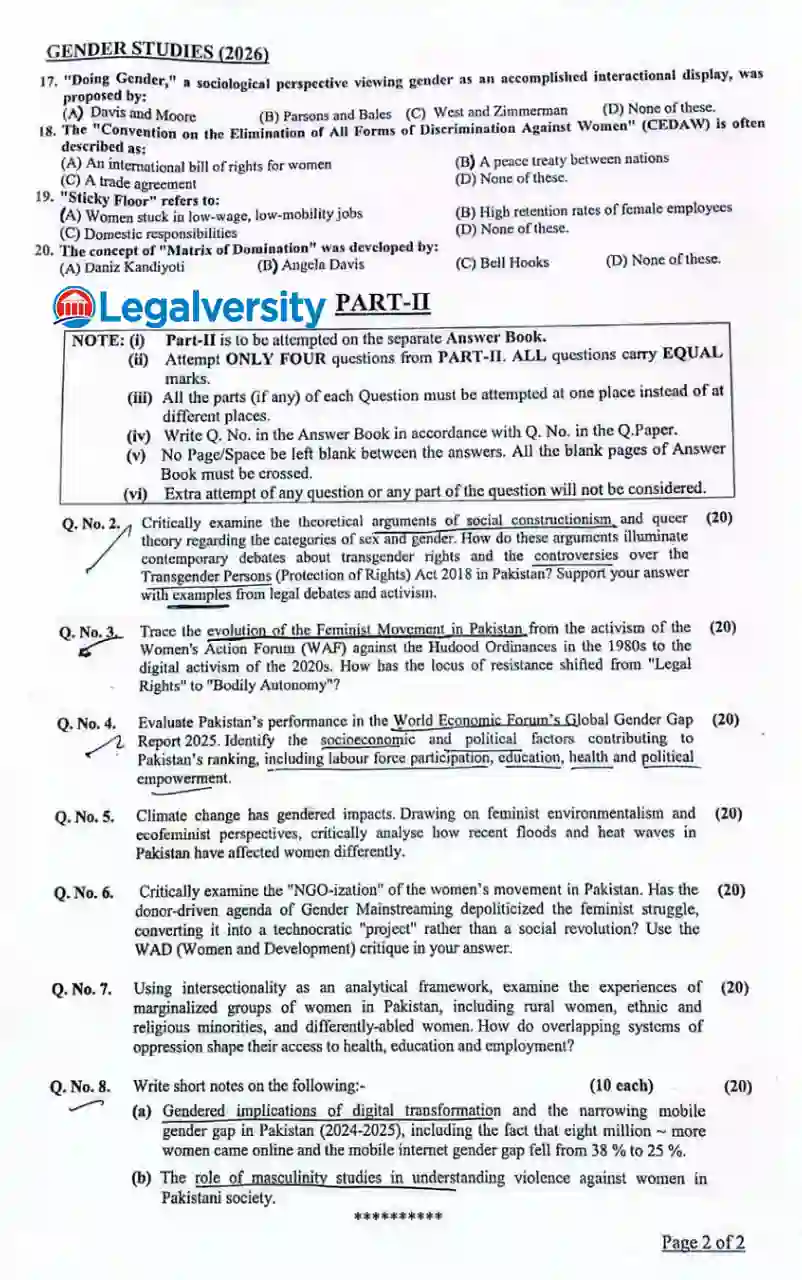
Q2. Critically examine the theoretical arguments of social constructionism and queer theory regarding the categories of sex and gender. How do these arguments illuminate contemporary debates about transgender rights and the controversies over the Transgender Persons (Protection of Rights) Act 2018 in Pakistan? Support your answer with examples from legal debates and activism.
Q3. Trace the evolution of the Feminist Movement in Pakistan, from the activism of the Women’s Action Forum (WAF) against the Hudood Ordinances in the 1980s to the digital activism of the 2020s. How has the locus of resistance shifted from “Legal Rights” to “Bodily Autonomy”?
Q4. Evaluate Pakistan’s performance in the World Economic Forum’s Global Gender Gap Report 2025. Identify the socioeconomic and political factors contributing to Pakistan’s ranking, including labour force participation, education, health, and political empowerment.
Q5. Climate change has gendered impacts. Drawing on feminist environmentalism and ecofeminist perspectives, critically analyse how recent floods and heat waves in Pakistan have affected women differently.
Q6. Critically examine the “NGO-ization” of the women’s movement in Pakistan. Has the donor-driven agenda of Gender Mainstreaming depoliticized the feminist struggle, converting it into a technocratic “project” rather than a social revolution? Use the WAD (Women and Development) critique in your answer.
Q7. Using intersectionality as an analytical framework, examine the experiences of marginalized groups of women in Pakistan, including rural women, ethnic and religious minorities, and differently-abled women. How do overlapping systems of oppression shape their access to health, education, and employment?
Q8. Write short notes on the following:-
- (a) Gendered implications of digital transformation and the narrowing mobile gender gap in Pakistan (2024-2025), including the fact that eight million more women came online and the mobile internet gender gap fell from 38% to 25%.
- (b) The role of masculinity studies in understanding violence against women in Pakistani society.
View CSS Gender Studies Past Paper 2026
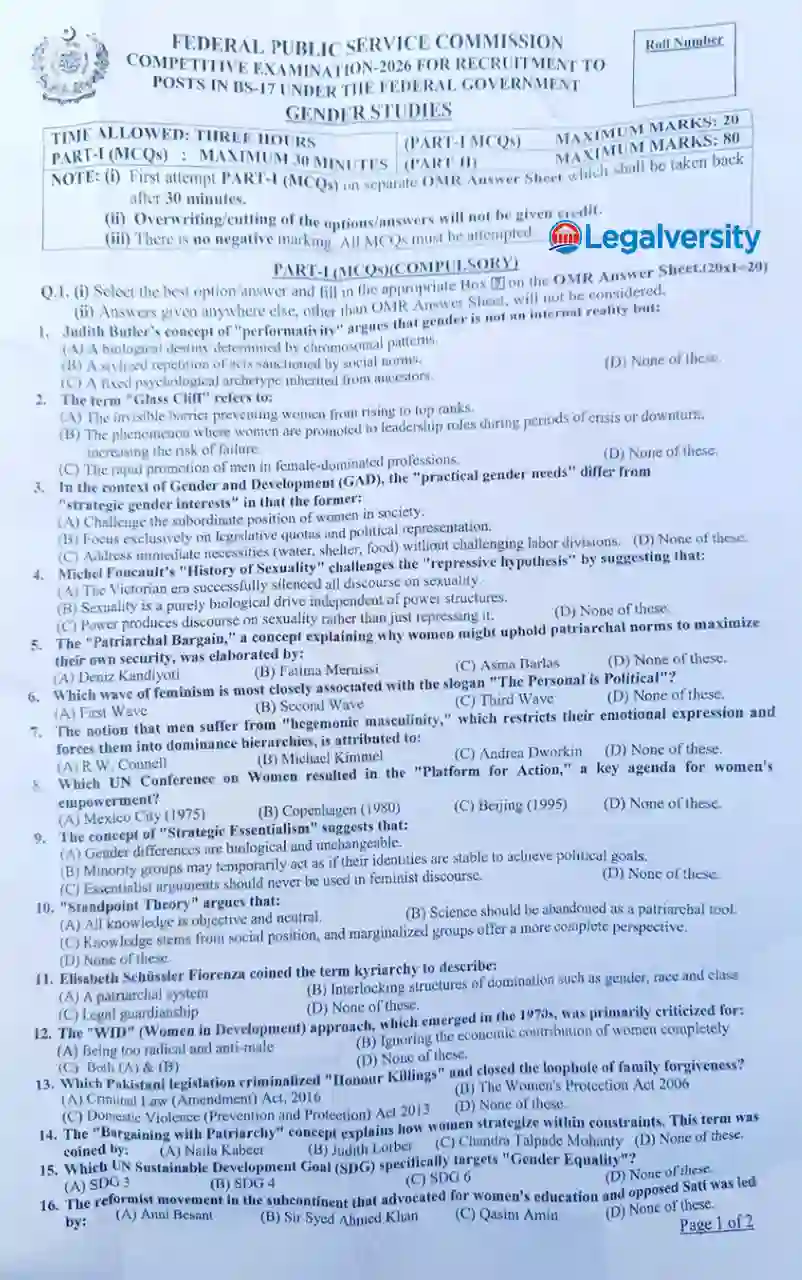
Critical Analysis – CSS Gender Studies Paper
The CSS Gender Studies Paper 2026 was conceptually rich, politically sensitive, and deeply rooted in both theory and Pakistani realities. It was not a paper for rote learners. It clearly rewarded candidates who could connect feminist theory with contemporary legal, social, and environmental debates in Pakistan. The overall tone of the paper was critical, analytical, and applied, meaning that simply defining concepts was not enough. You had to argue, evaluate, and contextualize.
Below is a structured critical analysis of the paper.
Overall Nature of the Paper
This paper was:
- Theoretically demanding (social constructionism, queer theory, ecofeminism, intersectionality, WAD critique)
- Context-driven (Transgender Act 2018, WAF, floods, digital activism, Global Gender Gap Report)
- Politically sensitive (bodily autonomy, NGO-ization, masculinity, transgender rights)
- Multidimensional (law, environment, economics, politics, digital transformation)
It tested whether candidates truly understand Gender Studies as a discipline — not as slogans, but as a critical framework.
Final Verdict
The CSS Gender Studies Paper 2026 was intellectually rich, contemporary, and critically framed. It rewarded clarity of thought, theoretical grounding, and the ability to link academic concepts with Pakistan’s legal and social realities. Candidates who prepared selectively or superficially would find it challenging. However, those who prepared conceptually and kept themselves updated with current debates would find it a fair and high-scoring paper.
Relevant Posts:
