
The CSS Environmental Sciences Paper 2026 is an optional paper that examines a candidate’s understanding of environmental systems, climate change, natural resource management, biodiversity, and sustainable development. Here you will find the CSS Environmental Sciences past paper 2026, along with an overall overview of the paper. Before moving to the questions, this introduction highlights the scientific and policy-oriented nature of the topics, the analytical depth required, and the way FPSC expects candidates to connect environmental theory with real-world challenges, especially in the context of Pakistan, helping aspirants prepare more effectively for future attempts.
CSS Environmental Sciences Past Paper 2026
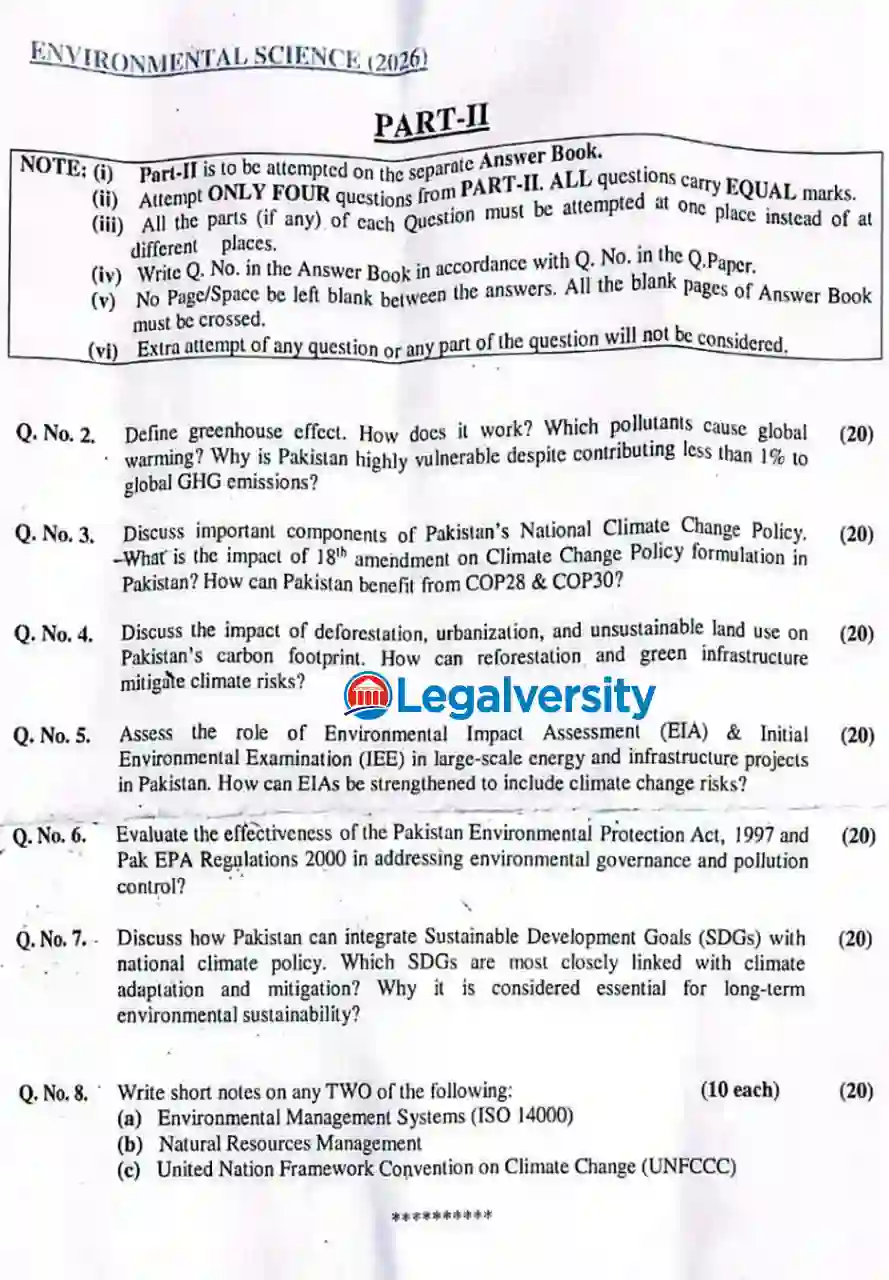
Q2. Define greenhouse effect. How does it work? Which pollutants cause global warming? Why is Pakistan highly vulnerable despite contributing less than 1% to global GHG emissions?
Q3. Discuss important components of Pakistan’s National Climate Change Policy. What is the impact of the 18th Amendment on Climate Change Policy formulation in Pakistan? How can Pakistan benefit from COP28 & COP30?
Q4. Discuss the impact of deforestation, urbanization, and unsustainable land use on Pakistan’s carbon footprint. How can reforestation and green infrastructure mitigate climate risks?
Q5. Assess the role of Environmental Impact Assessment (EIA) & Initial Environmental Examination (IEE) in large-scale energy and infrastructure projects in Pakistan. How can EIAs be strengthened to include climate change risks?
Q6. Evaluate the effectiveness of the Pakistan Environmental Protection Act, 1997, and the Pak EPA Regulations 2000 in addressing environmental governance and pollution control.
Q7. Discuss how Pakistan can integrate Sustainable Development Goals (SDGs) with its national climate policy. Which SDGs are most closely linked with climate adaptation and mitigation? Why is it considered essential for long-term environmental sustainability?
Q8. Write short notes on any TWO of the following:
- (a) Environmental Management Systems (ISO 14000)
- (b) Natural Resources Management
- (c) United Nations Framework Convention on Climate Change (UNFCCC)
View CSS Environmental Sciences past paper 2026:
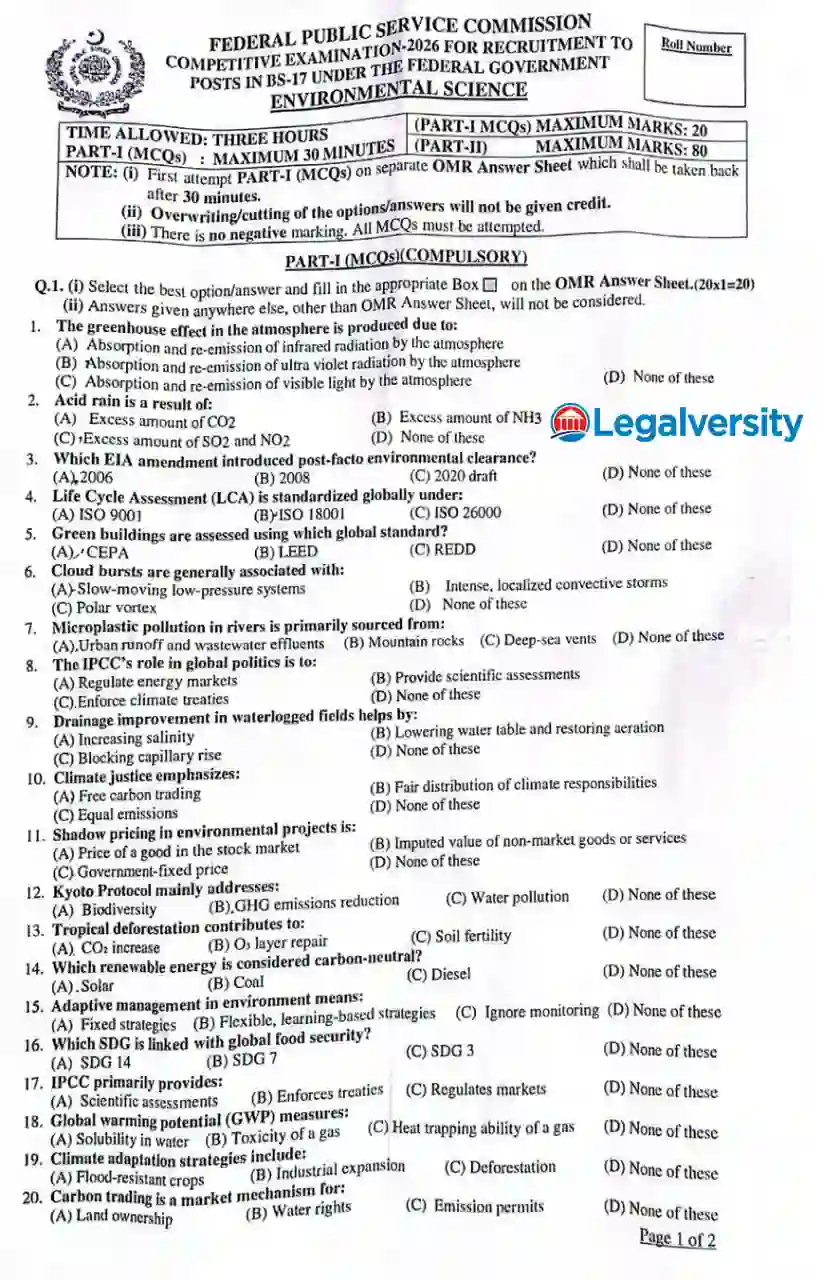
Critical Analysis of CSS Environmental Sciences Paper
The CSS Environmental Sciences Paper 2026 is analytical, policy-oriented, and Pakistan-focused, reflecting the evolving nature of environmental governance and climate discourse. The paper moves beyond theoretical definitions and emphasizes application, evaluation, and critical thinking, which aligns with international environmental scholarship and Pakistan’s contemporary climate challenges.
1. Strong Climate-Centric Focus
A major theme of the paper is climate change and governance.
- Q2 examines the scientific foundation (greenhouse effect, pollutants, global warming).
- Q3 links climate science to national policy and constitutional changes (18th Amendment).
- Q7 connects climate policy with SDGs and long-term sustainability.
Critical Observation:
The paper balances science + policy + governance, which is commendable. However, it heavily emphasizes climate change, potentially limiting coverage of other environmental domains like biodiversity loss, water governance, marine pollution, or environmental economics.
Pakistan-Specific Analytical Orientation
Nearly every question demands contextual understanding of Pakistan:
- Pakistan’s vulnerability despite <1% GHG emissions.
- National Climate Change Policy.
- Impact of the 18th Amendment.
- Environmental Protection Act 1997.
- EIA/IEE in infrastructure projects.
Strength:
This tests candidates’ ability to connect global environmental frameworks with local governance realities, an essential skill for future civil servants.
Challenge:
Candidates must possess:
- Knowledge of constitutional reforms
- Institutional weaknesses
- Implementation gaps
- COP negotiations and climate diplomacy
This makes the paper difficult for those relying only on textbook preparation.
2. Governance and Legal Framework Emphasis
Q5 and Q6 focus on:
- Environmental Impact Assessment (EIA)
- Pakistan Environmental Protection Act 1997
- Pak EPA Regulations 2000
Critical Insight:
The examiner is testing policy evaluation skills, not just description.
Candidates must:
- Identify strengths
- Highlight enforcement gaps
- Suggest reforms
- Integrate climate risk into EIAs
This shows a shift toward administrative realism and policy critique, which is a positive evolution in CSS standards.
4. Integration with Global Frameworks
The paper includes:
- COP28 & COP30
- UNFCCC
- SDGs
- ISO 14000
This reflects awareness of:
- Climate finance
- Global environmental diplomacy
- Corporate environmental responsibility
Critical Angle:
The paper expects aspirants to understand:
- Loss & Damage Fund
- Carbon markets
- International climate negotiations
- Sustainable development integration
This elevates the paper to an international standard.
5. Interdisciplinary Nature
The paper integrates:
- Environmental science (greenhouse gases)
- Law (PEPA 1997)
- Public administration (18th Amendment)
- International relations (COP, UNFCCC)
- Sustainable development (SDGs)
- Urban planning (green infrastructure)
Evaluation:
This interdisciplinary approach is intellectually strong but increases difficulty. It favors candidates who understand environmental issues holistically rather than memorizing isolated topics.
Conclusion
The CSS Environmental Sciences Paper 2026 reflects a modern, governance-driven, climate-centric approach. It tests whether candidates can:
- Connect science with policy
- Evaluate legal frameworks
- Understand international climate diplomacy
- Propose institutional reforms
It is a well-designed paper for selecting administrators capable of handling Pakistan’s growing environmental challenges, particularly climate vulnerability, institutional fragmentation, and sustainable development integration.
Relevant Posts:
