
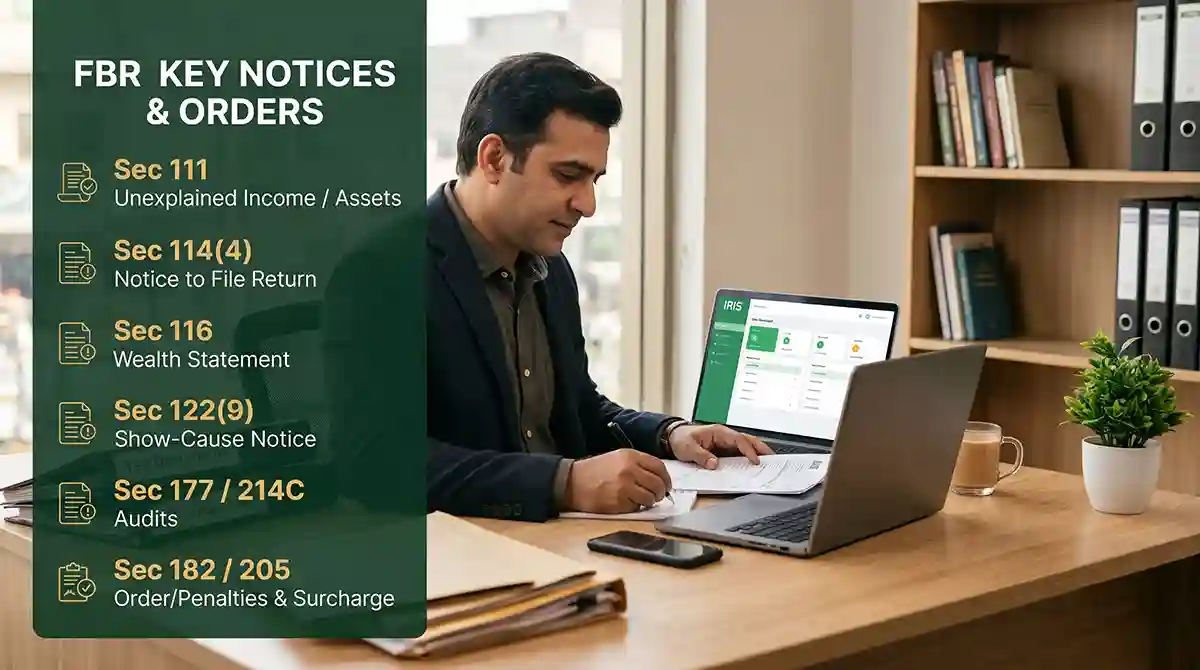
Getting an SMS or email alert from the Federal Board of Revenue (FBR) IRIS portal can make anyone’s heart skip a beat. However, receiving a message from the FBR does not automatically mean you are in trouble. In most cases, it is simply a routine request for missing information, a reminder to file, or a clarification about a bank transaction. Here I am explaining you about the FBR notices and orders that FBR sent to its taxpayer on different occasion. Being a Pakistani citizen you must understand the reasons and purposes of each notice that FBR serve.
Under the Income Tax Ordinance, 2001, FBR communications generally fall into three categories:
- Notice: The FBR is asking you for information, a return, or an explanation.
- Order: A tax officer or appellate authority has made a formal decision on your case.
- Demand: The FBR is formally asking you to pay a specific amount of tax or surcharge.
Below is a plain-English breakdown of the 22 most common FBR notices, orders, and demands, why you might receive them, and how to handle them calmly and correctly.
1. Filing & Basic Compliance Notices
Section 114(4) – Notice to File Return (Notice)
- Purpose: Requires a person to submit their income tax return.
- Why it is served: You earned taxable income, bought a property or car, or triggered a financial threshold, but you did not file your return by the annual deadline.
- Practical Example: You bought a 1300cc car in March and paid withholding tax at registration, so the FBR knows you have the financial means to be a filer, yet you didn’t file a return for that tax year.
- How to reply: Log into your FBR IRIS portal and file your income tax return within the time given in the notice. If you genuinely had no taxable income and are not legally required to file, submit a written reply explaining this with supporting proof.
Section 116 – Wealth Statement Notice (Notice)
- Purpose: Requires you to submit a Wealth Statement along with a wealth reconciliation.
- Why it is served: You filed your income tax return, or were asked to file one, but your list of personal assets, liabilities, and household expenses is missing or incomplete.
- Practical Example: A salaried individual files their annual income form but forgets to fill out the Wealth Statement tab showing their bank balance and monthly expenses.
- How to reply: Complete and submit your Wealth Statement (Form 116) on IRIS by the deadline, ensuring your opening wealth, current year’s income, expenses, and closing wealth balance out to zero difference.
Section 120(3) – Deficiency in Return (Notice)
- Purpose: Points out that the income tax return you filed is incomplete or deficient.
- Why it is served: Your return has a technical error, missing attachment, or unverified figure that prevents it from being treated as a complete assessment.
- Practical Example: You claimed a tax credit for a charitable donation or tuition fee, but forgot to attach the required certificate or left a mandatory field blank.
- How to reply: Log into IRIS, review the exact deficiency mentioned in the notice, and remove the deficiency by submitting the missing details or revising the return within the stated time.
2. Information, Audits & Unexplained Assets
Section 176 – Notice to Obtain Information (Notice)
- Purpose: Requires you to provide specific information, documents, or evidence.
- Why it is served: The FBR is cross-checking a transaction either yours or someone you did business with and needs documentary proof to verify it.
- Practical Example: The FBR notices a large cash deposit in your bank account and asks for your bank statement and source of funds.
- How to reply: Gather the exact documents requested (such as bank statements, salary slips, or sale deeds) and upload them with a brief, polite cover letter on IRIS by the deadline.
Section 177 – Audit (Notice)
- Purpose: Calls for your financial records so the Commissioner can conduct an audit of your tax affairs.
- Why it is served: The Commissioner has selected your case for an audit based on risk factors, discrepancies in your return, or unusual drops in declared income.
- Practical Example: A shop owner’s bank deposits increased by 50% this year, but their declared business income dropped compared to last year.
- How to reply: Cooperate with the tax officer and produce the requested books of accounts, invoices, and bank statements within the given timeframe. Keeping clean records makes this process straightforward.
Section 214C – Selection for Audit (Notice)
- Purpose: Informs you that your case has been selected for audit by the FBR Board (often through computer balloting or parametric selection).
- Why it is served: Unlike Section 177 (chosen by a local Commissioner), this selection happens centrally at the FBR Board level.
- Practical Example: Your NTN is picked during the FBR’s annual computerized audit ballot.
- How to reply: Do not panic being selected does not mean you did anything wrong. Cooperate with the assigned officer and submit your supporting records when formally requested.
Section 111 – Unexplained Income or Assets (Order)
- Purpose: Adds unexplained money, assets, or expenditures directly to your taxable income.
- Why it is served: You bought an asset, made a bank deposit, or spent money that does not match your declared income, and you failed to provide a satisfactory explanation.
- Practical Example: You declared an annual salary of PKR 1.2 million, but bought a plot worth PKR 5 million without showing a bank loan, inheritance, or prior savings to justify it.
- How to reply: Provide clear documentary proof explaining the source of the funds (e.g., gift deed, inheritance papers, bank loan agreement, or foreign remittance PRC). If an order has already been passed against you, you must either pay the resulting tax or file an appeal.
3. Assessments, Amendments & Mistakes
Section 121 – Best Judgement Assessment (Order)
- Purpose: Allows the FBR to estimate and assess your tax when no return or records were filed.
- Why it is served: You ignored previous notices to file a return or submit records, leaving the tax officer to calculate your tax based on whatever information they have (like bank data or property purchases).
- Practical Example: You ignored a Section 114(4) notice to file your return, so the officer estimated your income based on your utility bills and bank transactions and issued a tax bill.
- How to reply: You can pay the assessed tax, file the overdue return (where legally permitted), or challenge the estimated assessment by filing an appeal.
Section 122(9) – Show-Cause Notice (Notice)
- Purpose: Confronts you with specific findings before the FBR officially amends your tax assessment.
- Why it is served: The law requires the FBR to give you a fair chance to explain your side before increasing your tax bill.
- Practical Example: The FBR believes you under-reported your rental income by PKR 300,000 and sends this notice asking why they shouldn’t add that amount to your taxable income.
- How to reply: Never ignore a Show-Cause Notice. Reply in writing via IRIS within the given time, addressing each point with clear facts and attached proof (like your actual rent agreement).
Section 122(1) – Amendment of Assessment (Order)
- Purpose: Officially amends or re-amends your existing tax assessment.
- Why it is served: After issuing a Show-Cause Notice (Section 122(9)), the officer was not satisfied with your reply or you didn’t reply at all so they finalized the new, higher tax calculation.
- Practical Example: Following the rental income notice above, you didn’t respond, so the officer issued this order officially adding PKR 300,000 to your income and calculating extra tax.
- How to reply: Review the order carefully. If the calculation is fair, pay the amended tax demand; if you disagree, file an appeal with the Commissioner Appeals within the statutory deadline.
Section 161 – Failure to Withhold / Deduct Tax (Order)
- Purpose: Holds a withholding agent personally liable for tax they were supposed to deduct from someone else’s payment.
- Why it is served: Businesses and certain individuals are legally required to deduct withholding tax when paying salaries, rent, or suppliers. If you fail to deduct and deposit it, the FBR recovers it from you.
- Practical Example: A small business owner pays PKR 200,000/month in office rent but forgets to deduct withholding tax from the landlord’s payment.
- How to reply: If the landlord has already paid their own tax, submit proof of their tax payment to avoid double taxation. Otherwise, pay the required tax and surcharge, or file an appeal if you believe you were not legally required to withhold.
Section 221 – Rectification of Mistake (Order)
- Purpose: Corrects a clear, obvious mistake apparent from the official record.
- Why it is served: Either you or the FBR spotted a clerical, mathematical, or factual error in a previously issued order (not a complex legal dispute).
- Practical Example: Your tax order accidentally typed your paid tax as PKR 10,000 instead of PKR 100,000, creating a false tax demand.
- How to reply: If the FBR issues a rectification order, review the corrected figures carefully. If you spot a clear mistake in an FBR order, you can proactively submit an application under Section 221 asking the officer to fix it.
4. Tax Demands, Penalties & Recovery
Section 137 – Notice of Demand (Demand)
- Purpose: Formally notifies you of the exact tax amount due and the deadline for payment.
- Why it is served: Whenever an assessment, amendment, or penalty order results in tax payable, the FBR issues this bill so you know how much to pay and by when.
- Practical Example: After an amended assessment order (Section 122(1)), you receive a Notice of Demand for PKR 45,000 payable within 30 days.
- How to reply: Generate a Payment Slip ID (PSID) on IRIS and pay the tax within the stated period. If you are appealing the underlying order, consult a tax advisor about applying for a stay of recovery.
Section 182 – Penalty Order (Order)
- Purpose: Imposes a financial penalty for a tax offence or default.
- Why it is served: You missed a filing deadline, failed to comply with a notice, or concealed income.
- Practical Example: Filing your annual income tax return after the deadline without an approved extension can trigger a late-filing penalty order.
- How to reply: Pay the penalty via PSID if the default was genuine, or challenge the order in appeal if you had a reasonable excuse or if the penalty was wrongly applied.
Section 205 – Default Surcharge (Demand)
- Purpose: Charges an additional surcharge (similar to late-payment interest) for paying tax after the due date.
- Why it is served: You did not pay your due tax by the deadline specified in the law or in a Notice of Demand.
- Practical Example: You owed PKR 50,000 in tax due on September 30, but you didn’t pay it until February. The FBR charges a default surcharge for the delayed months.
- How to reply: Pay the default surcharge along with your principal tax amount via PSID to stop further charges from accumulating.
Section 138 – Recovery of Tax (Notice)
- Purpose: Initiates formal steps to recover unpaid tax directly from your property or assets.
- Why it is served: You ignored a Notice of Demand (Section 137) and left your tax arrears unpaid past the deadline.
- Practical Example: A taxpayer ignores a PKR 200,000 tax demand for months, prompting the FBR to warn of attaching their movable or immovable property.
- How to reply: Act immediately. Pay the outstanding arrears before coercive recovery measures (like freezing or seizing property) begin, or secure a legal stay order if an appeal is pending.
Section 140 – Recovery from Third Parties (Notice)
- Purpose: Recovers your unpaid tax directly from banks or other people who hold your money.
- Why it is served: If you still haven’t paid your overdue tax, the FBR can legally instruct your bank, employer, or clients to send your money directly to the government.
- Practical Example: The FBR sends a Section 140 notice to your bank, instructing them to freeze and transfer PKR 150,000 from your account to clear your unpaid tax bill.
- How to reply: Once issued, the bank or third party is legally bound to pay the amount to the FBR. To prevent this, always address demands at the Section 137 stage or immediately contact your tax officer with proof of payment or an appeal stay order.
5. Appeals & Refunds
Section 129 – Appeal Order (Commissioner Appeals) (Order)
- Purpose: Delivers the first-level appellate decision on a tax order you challenged.
- Why it is served: You disagreed with a tax officer’s order (like an amendment or penalty) and filed an appeal with the Commissioner (Appeals). This order states whether you won, lost, or got partial relief.
- Practical Example: The Commissioner (Appeals) agrees that your bank deposit was a loan and deletes the extra tax added by the tax officer.
- How to reply: If the decision is in your favor, ensure it is implemented. If you disagree with the decision, either comply with it or file a second-tier appeal with the Appellate Tribunal.
Section 131 – Appellate Tribunal Order (Order)
- Purpose: Delivers the second-tier appellate decision from the Appellate Tribunal Inland Revenue (ATIR).
- Why it is served: Either you or the FBR was unhappy with the Commissioner (Appeals) decision and took the matter to the Tribunal.
- Practical Example: You appealed a rejected business expense to the Tribunal, and the Tribunal issues its final factual ruling.
- How to reply: Comply with the Tribunal’s order. If you believe the Tribunal made a mistake on a point of law, you can file a Reference to the High Court.
Section 133 – Reference to High Court (Order)
- Purpose: Provides a High Court decision on a strict question of law arising from a Tribunal order.
- Why it is served: A legal interpretation not just a dispute over numbers or facts was escalated to the High Court for a definitive ruling.
- Practical Example: A dispute over whether a specific type of foreign remittance qualifies for a legal tax exemption under the Ordinance.
- How to reply: Comply with the High Court’s decision. (Further appeal is only possible to the Supreme Court in specific legal circumstances.)
Section 124 – Assessment Giving Effect to an Order (Order)
- Purpose: Re-computes your tax bill to implement a decision made by an appellate authority or court.
- Why it is served: When you win an appeal (under Sections 129, 131, or 133), the local tax officer must issue a fresh order updating your tax record and reducing or canceling the old demand.
- Practical Example: After you win your appeal, the officer issues a Section 124 order reducing your tax demand from PKR 100,000 down to PKR 0.
- How to reply: Check the math carefully to make sure the officer gave you the full relief awarded by the court. Pay any remaining balance or contest the calculation if the officer made an error.
Section 170 – Refund Order (Order)
- Purpose: Officially decides on a tax refund claim you submitted.
- Why it is served: You paid more tax than you owed (for example, through excess withholding tax on salary, bank transactions, or electricity bills) and filed a refund application on IRIS.
- Practical Example: A salaried employee had extra tax deducted by their employer and applied for a PKR 25,000 refund. The FBR verifies the claim and issues a Refund Order.
- How to reply: If approved, ensure your IBAN is updated on IRIS to receive the refund directly in your bank account. If your refund claim is rejected, you have the right to file an appeal.
4 Golden Rules for Handling Any FBR Notice
- Always verify on IRIS first: Never trust random WhatsApp messages or phone calls claiming to be from the FBR. Log directly into your official IRIS account (
iris.fbr.gov.pk) and check your Inbox to confirm the notice is genuine. - Never ignore a deadline: Even if you need more time to gather bank statements or receipts, submit a brief Extension Request on IRIS before the due date expires. Silence almost always leads to an unfavorable ex-parte order.
- Keep replies factual and documented: Tax officers rely on paper trails, not verbal explanations. Always attach clear, readable PDFs of bank statements, salary certificates, or agreements.
- Know when to get help: Routine notices like filing a return (114(4)) or updating a wealth statement (116) are easy to handle yourself. However, if you receive a Show-Cause Notice (122(9)), an Audit Notice (177/214C), or an Assessment Order (121/122(1)), consulting a qualified tax advisor can save you from costly mistakes.
If you wish to learn how to file income tax return for all categories you can refer to our Income Tax Return Master Course.
Also read:
- How to File Tax Return for Salary Person in 2026 in Pakistan
- How to Get Withholding Tax Certificate Pakistan
- Understanding “Household Effects” in FBR Income Tax Return
