
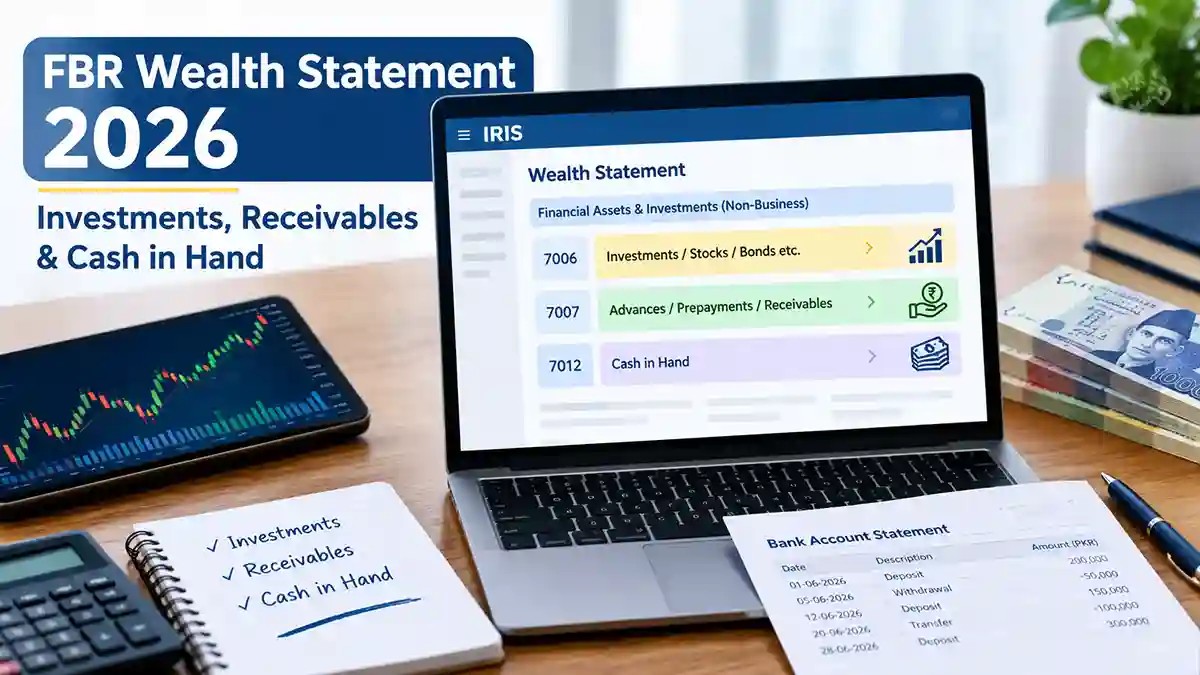
When filing the FBR Income Tax Return, many taxpayers understand the income section but get confused when they reach the Wealth Statement. One of the confusing areas is Financial Assets & Investments (Non-Business), where IRIS shows fields such as Investments / Stocks / Bonds etc., Advances / Prepayments / Receivables, and Cash in Hand.
The purpose of these fields is simple: FBR wants the taxpayer to disclose the assets that they actually own at the relevant year-end. The Wealth Statement is not another income statement. It is a statement of your assets and liabilities, and it must reconcile with your income and expenses. FBR states that the Wealth Statement will not be successfully submitted if the change in wealth does not reconcile with the difference between income and expenses.
So, when using these fields, the most important question is not “What amount should I enter?” but rather “What exactly does this amount represent?”
Understanding the Three Fields
In the IRIS Wealth Statement, these three fields are separate because your money can exist in different forms. You may have money invested in shares, money that someone else owes you, or physical cash in your possession. These are all assets, but they are not the same type of asset.
| IRIS Field | Code | Simple Meaning |
|---|---|---|
| Investments / Stocks / Bonds etc. | 7006 | Money personally invested in financial assets |
| Advances / Prepayments / Receivables | 7007 | Money or value that is due to you or paid as an advance/deposit |
| Cash in Hand | 7012 | Physical cash you actually hold |
FBR’s Wealth Statement structure identifies Code 7006 as Investment (Non-Business), Code 7007 as Debt (Non-Business), including advances, prepayments and receivables, and Code 7012 as Cash (Non-Business).
The word Non-Business is also important. These fields are for assets that are personal rather than assets forming part of your business capital or business assets.
1. Investments / Stocks / Bonds etc. – Code 7006
The easiest way to understand this field is:
If you have personally invested your money somewhere and you still own that investment, it may be reported under this category.
Many people think this field is only for Pakistan Stock Exchange shares, but the category is broader. FBR’s Wealth Statement structure includes accounts, annuities, bonds, certificates, debentures, deposits, funds, instruments, policies, shares, stocks and units under Investment (Non-Business).
For example, suppose you have personally invested Rs. 1,000,000 in shares. That investment is part of your wealth. You should not treat the Rs. 1 million as physical cash simply because the money originally came from your bank account.
The same basic idea applies to other financial investments. If you have a qualifying investment in a fund, certificate, bond or similar financial instrument, you should look at the appropriate investment category rather than treating it as cash.
A simple example
Suppose Ahmed has the following at the end of the tax year:
| Asset | Amount |
|---|---|
| PSX shares | Rs. 1,000,000 |
| Physical cash | Rs. 150,000 |
| Money receivable from a friend | Rs. 300,000 |
Ahmed does not have Rs. 1.45 million as cash in hand. His wealth is divided into different forms.
The Rs. 1 million shares are an investment, the Rs. 300,000 is potentially a receivable, and the Rs. 150,000 is physical cash.
Investment Is Different From Investment Income
This is another point that taxpayers often misunderstand.
Suppose you have shares worth Rs. 1 million and receive Rs. 80,000 dividend during the year.
The Rs. 1 million investment and the Rs. 80,000 dividend are two different things.
The shares are an asset that forms part of your Wealth Statement. The dividend is income that needs to be dealt with in the relevant income section.
Similarly, if you sell shares and make a capital gain, the gain is a separate tax matter. You should not simply treat the entire investment and its income as one figure.
What About a Bank Balance?
This is an area where taxpayers should be careful.
A bank balance is not the same thing as physical cash in hand. FBR’s investment category has historically included accounts and deposits, while Code 7012 separately represents Cash (Non-Business).
So, if you have Rs. 500,000 in your bank account, don’t automatically enter Rs. 500,000 as Cash in Hand just because you can withdraw it.
The important thing is to identify where the money is actually held and select the appropriate current IRIS category.
2. Advances / Prepayments / Receivables – Code 7007
This field is confusing mainly because of the word Debt used in the formal FBR description.
In simple terms, think about it like this:
You have money or value that belongs to you, but you don’t currently have it in your hands because it is with someone else, has been paid in advance, or is represented by a receivable, deposit or similar claim.
FBR’s category includes Advance, Debt, Deposit, Prepayment, Receivable and Security.
Personal loan given to someone
Suppose you give your friend Rs. 500,000 as a personal loan.
You no longer have Rs. 500,000 in your pocket or bank account, but you still have a right to receive that money back.
So the money has not simply disappeared from your wealth.
You now have a receivable/loan asset.
This is very different from borrowing Rs. 500,000 from your friend. If you borrow the money, you owe it to someone else and it becomes a liability rather than your own asset.
| Situation | Basic nature |
|---|---|
| You give someone Rs. 500,000 | Amount receivable by you |
| You borrow Rs. 500,000 | Amount payable by you |
| Someone owes you Rs. 300,000 | Receivable |
| You owe someone Rs. 300,000 | Payable/liability |
This distinction is extremely important when preparing a Wealth Statement.
Property Advance
Another common example is a property transaction.
Suppose you agree to purchase a plot and pay the seller:
Rs. 2,000,000 as advance.
At the end of the tax year, the property has not yet been transferred to you.
You have already paid the money, but you don’t own the property yet. Therefore, you should not simply make the Rs. 2 million disappear from your Wealth Statement.
The nature and status of that advance should be properly reflected as an asset/claim according to the actual transaction.
The same basic thinking applies to refundable deposits and qualifying prepayments.
What Is a Receivable?
A receivable simply means:
Someone owes you money.
For example, you sell something for Rs. 1 million, but the buyer pays you only Rs. 700,000 and agrees to pay the remaining Rs. 300,000 later.
You have a Rs. 300,000 receivable.
You don’t have the cash yet, but you have a right to receive it.
That is why it should not be ignored when preparing your Wealth Statement.
3. Cash in Hand – Code 7012
This is probably the simplest field, but it is also one of the fields most frequently misunderstood.
Cash in Hand means physical cash that you actually hold.
FBR’s Wealth Statement identifies Code 7012 as Cash (Non-Business), with the return structure further breaking cash into items such as notes and coins.
For example, suppose on 30 June you have:
Rs. 150,000 physical cash
at home or otherwise physically in your possession.
That is the basic example of Cash in Hand.
But suppose you also have Rs. 700,000 in your bank account. You should not simply add the bank balance to the physical cash and call the entire Rs. 850,000 “Cash in Hand.”
The two amounts are held in different forms.
Example
Suppose your financial position is:
| Asset | Amount |
|---|---|
| Physical cash | Rs. 150,000 |
| Bank balance | Rs. 700,000 |
| PSX investment | Rs. 1,000,000 |
| Personal loan receivable | Rs. 300,000 |
The Rs. 150,000 is the amount that represents physical cash.
The other amounts need to be considered under their appropriate categories.
Why You Should Not Just Increase Cash in Hand to Reconcile
This is one of the most important practical points.
Some taxpayers prepare their Wealth Statement and discover that it does not reconcile. They then increase or decrease their Cash in Hand figure until IRIS shows the required result.
That is not the right approach.
FBR clearly states that the Wealth Statement must reconcile with the previous year’s wealth and the current year’s income and expenses. If it does not reconcile, the return cannot be successfully submitted.
For example, suppose last year’s net wealth was Rs. 5 million and this year’s net wealth is Rs. 7 million. There has been an increase of Rs. 2 million.
The taxpayer should be able to explain that change through the relevant income, expenses, assets, liabilities and other applicable transactions.
You should not simply write Rs. 2 million in Cash in Hand if you never actually had that amount as physical cash.
A Complete Practical Example
Let’s take a simple example of a salaried person.
At 30 June 2026, Ali has:
- Rs. 1,000,000 in PSX shares
- Rs. 400,000 lent to his brother
- Rs. 150,000 physical cash
- Rs. 600,000 in a bank account
His financial position can be understood like this:
| Item | Amount | Basic category |
|---|---|---|
| PSX shares | Rs. 1,000,000 | Investment |
| Money lent to brother | Rs. 400,000 | Receivable/debt |
| Physical cash | Rs. 150,000 | Cash in hand |
| Bank balance | Rs. 600,000 | Appropriate bank/account category |
The important point is that Ali has not simply got Rs. 2.15 million “cash.”
He has different types of financial assets.
This is exactly why IRIS provides separate fields.
Who Usually Uses These Fields?
There is no rule that says a particular profession must use these fields.
It depends on the person’s actual financial position.
A salaried employee who has purchased shares can use the investment category. A business owner who has given a personal loan to someone may have a receivable. A person who keeps physical cash may have Cash in Hand.
For example:
| Person | Possible situation |
|---|---|
| Salaried employee | Owns PSX shares |
| Business owner | Has personally invested in shares |
| Freelancer | Has money receivable from someone |
| Property buyer | Has paid a property advance |
| Investor | Owns funds, shares or other investments |
| Any taxpayer | Holds physical cash |
So these fields are not limited to business people or wealthy taxpayers. The relevant question is whether the taxpayer actually owns an asset that falls into the category.
The Difference in One Simple Table
If you want to remember the whole concept, use this:
| If your situation is… | Think… |
|---|---|
| “I invested my money in shares or another financial investment.” | Investment – 7006 |
| “Someone owes me money.” | Receivable / Debt – 7007 |
| “I paid money in advance and still have a related right/claim.” | Advance / Prepayment – 7007 |
| “I have physical notes and coins.” | Cash in Hand – 7012 |
| “I borrowed money from someone.” | Liability, not my receivable |
| “The money is in my bank account.” | Bank/account category, not automatically cash in hand |
One More Important Point for Business Owners
The heading says Financial Assets & Investments (Non-Business).
Therefore, a business owner should not automatically put all business assets into these fields.
For example, if a person operates a business and has business capital, business stock, business receivables or other business assets, those need to be considered according to their appropriate business-related categories.
On the other hand, if the same person uses personal savings to purchase the PSX shares for himself, that is a personal/non-business investment.
This distinction becomes particularly important when a taxpayer has both business and personal financial activities.
What Records Should You Keep?
You should be able to support the figures you declare.
For investments, keep brokerage or investment statements. For receivables and advances, keep agreements, receipts, bank-transfer records or other relevant evidence. For property advances, keep the sale agreement and payment evidence.
For Cash in Hand, the amount should be a reasonable representation of the physical cash actually held at the relevant date.
The purpose is not to create unnecessary paperwork. It is simply to make sure that if you later need to explain your Wealth Statement, you can show how you arrived at the figures.
Conclusion
These three fields become much easier when you stop thinking about them as complicated tax terms.
Code 7006 is basically about your personal investments. If you have invested your money in shares, funds, bonds, certificates or another qualifying financial investment, this is the category you need to examine.
Code 7007 is about amounts such as advances, prepayments and receivables. If your money is with another person or tied up in an advance or similar claim, it may belong here.
Code 7012 is about physical cash. It is not a general field for all the money you own. A bank balance, investment or receivable should not automatically be treated as Cash in Hand.
The easiest way to remember it is:
Investment means your money is invested. Receivable means your money is owed to you. Cash in Hand means you physically have the cash.
Most importantly, don’t enter figures simply to make the Wealth Statement reconcile. First identify what the amount actually represents, put it into the appropriate category, and then check the overall reconciliation.
FBR confirms that the Wealth Statement is an integral part of the online filing process and that it must reconcile with the taxpayer’s income, expenses and previous wealth before the return can be successfully submitted.
Note: IRIS forms and their fields can be updated by FBR. For Tax Year 2026, taxpayers should use the current IRIS form and applicable FBR instructions when actually filing. The explanations above are intended to make the three fields shown in the IRIS Wealth Statement easier to understand, not to replace the taxpayer’s obligation to report their actual financial position correctly.
Also read:
